
Counterfeit drug crimes typically earn light sentences. How did Safe Chain Solutions co-owners, the Boyd brothers, end up with 18 and 20 years?
March 23, 2026
Charles and Patrick Boyd received 20 and 18 years in prison for a variety of counterfeit drug crimes, along with wire fraud. Here’s a breakdown of the sentences by count, which will be served concurrently.
Interestingly, the charges involving wire fraud drove much higher penalties than the shipping of unsafe medicine into the supply chain. That sentencing relied on the government proving that the Boyds deliberately defrauded their pharmacy customers, and on the scale of the fraud.

Sentencing results, USA v Charles and Patrick Boyd, March 2026
What evidence of wire fraud did the government produce?
Once prosecutors have established deliberate fraud, any electronic communication that furthers that scheme is evidence of wire fraud.
For example, the government’s indictment cites this October 2020 email as the basis for Count 7, perhaps because it establishes activity in Florida, where the case was prosecuted.
Right now, we don’t have transcripts showing how prosecutors used this evidence at trial, but the indictment tells us that this October 2020 email from Brosius to the Boyds was the trigger for a payment from Florida to elsewhere in the country. Brosius shares that he told his sales team that one of their black market suppliers, “blvd,” was “back in play.”
![A 10/30/2020 email from Adam Brosius to Pat Boyd that reads: I just sent this to my people [5:54 PM] Adam Brosius (Guest) great month between the 2 locations we sold about 12.5 million that is 150 million a year! with blvd back in play hopefully we can continue the momentum November will be a shortened business month with us losing at least 1.5 - 3 days to holidays and people closing down about 19 full business days have a great weekend monday we start back at $0 [5:56 PM] Adam Brosius (Guest) we have 3 new exclusives -- all starting next week hopefully those will boost everyone's sales and energy level (outside of HIV) (1 liked) [5:57 PM] Adam Brosius (Guest) I will put the info together over the weekend](https://www.safemedicines.org/wp-content/uploads/2026/03/Exhibit-20-back-in-play.png "Exhibit 020")
An email from Adam Brosius to Pat Boyd, October 30, 2020 (Trial exhibit 20, USA v Boyd)
For context, the Boyds were already illegally selling medicines from Boulevard without pedigrees and coaching suppliers on how to produce documentation after the fact. In August and September they had received complaints from several pharmacies about those products (See exhibits 351 and 173). A September 2020 Microsoft Teams chat has Patrick Boyd explaining that the Boulevard products were less expensive than their other suppliers (exhibit 425). The other supplier they mention, Gentek, was also selling problematic products, such as the sealed Biktarvy bottle filled with Excedrin discussed in exhibit 149.
Taken together with Brosius’ email, documents like these (and there are many) show that the company was continuing to sell questionable medicines despite warning signs, with an eye to greater profits.

In this August 2020 email Charles Boyd corrects an oddly-named consultant, "King Kimchi," who had been hired to deliver DSCSA transaction logs for medicines Safe Chain had already sold.
Boyd clearly knew what safety paperwork was required of licensed pharmaceutical suppliers.
(Trial exhibit 351, USA v Boyd)
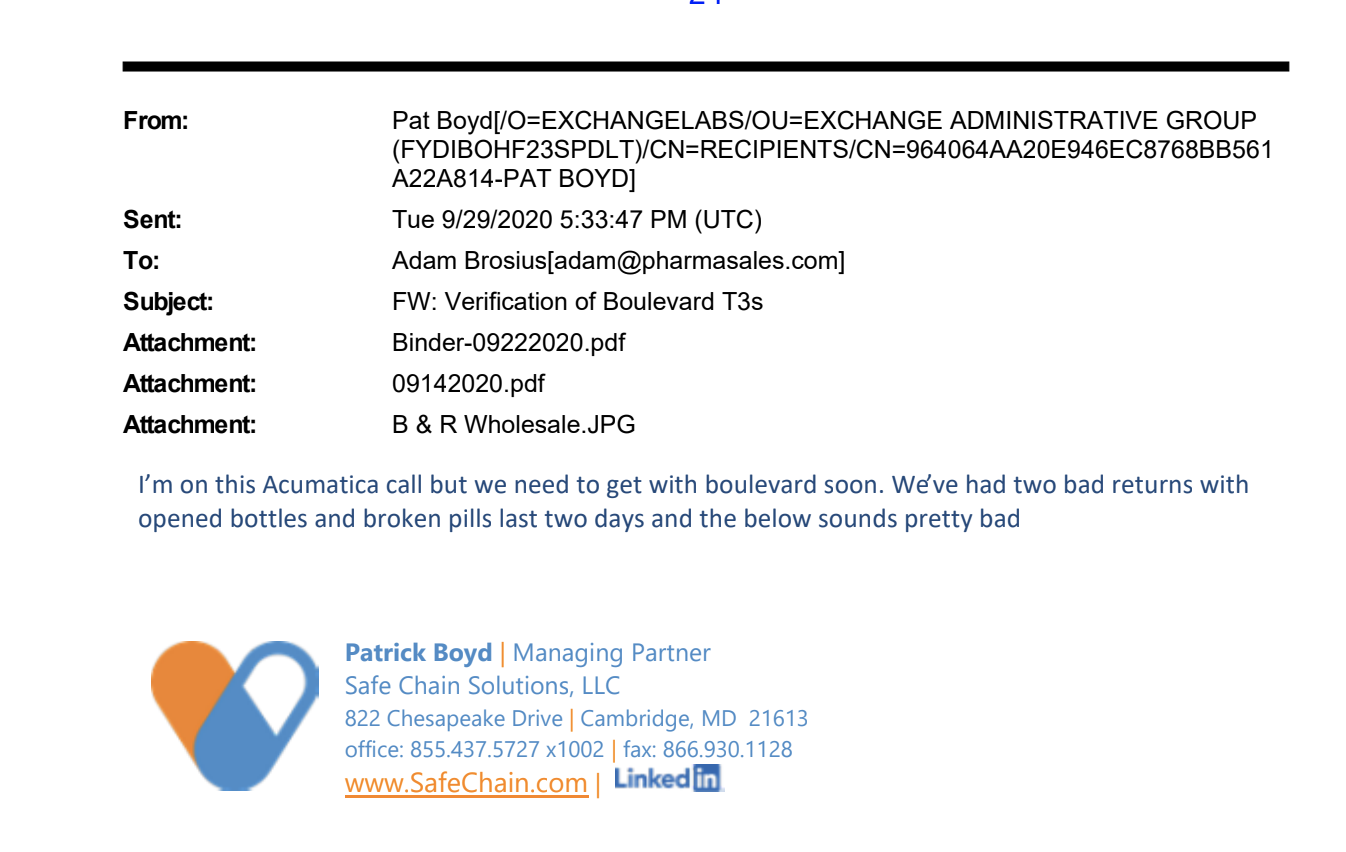
Email from Pat Boyd to Adam Brosius, September 29, 2020 (Trial exhibit 173)

Chat between Pat Boyd and Safe Chain's compliance officer, September 10, 2020 (Trial exhibit 425)

Email from Charles Boyd to Gilead Sciences, August 21, 2020 (Trial exhibit 149)
How does this translate to such high sentences?
We can’t know exactly what the judge was thinking, but sentence lengths are guided by formulaic guidelines listed in presentencing reports (PSRs) that are often unavailable to the public. In USA v Boyd the government summarized some of the PSR in its sentencing memorandum, which is also a rebuttal to defendants’ protests about the report.
The government’s memo shows a number of factors that call for longer sentences, among them abuse of trust, number of victims, vulnerable nature of the victims, significant role in controlling the scheme, risk of death and bodily injury, being part of the trusted supply chain, etc. None of those is a bigger factor, however, than financial loss. The U.S. sentencing guidelines say that causing a financial loss greater than $65mm, but less than $150mm, is a 24 level enhancement. As the government writes,
The PSR calculated losses of $92.8 million based on the amount the Defendants paid five black-market suppliers for diverted and previously dispensed HIV drugs. See exhibit 40 (Financial Summary Exhibit). Using the amount the Defendants paid for the illicit HIV drugs is, if anything, a conservative estimate of loss. The Defendants purchased these black-market drugs at steep discounts and resold them to pharmacies for profit.

Sentencing enhancements listed in the government's sentencing memo

Trial exhibit 40
The conclusion one must come to is that being a successful black market medicine trafficker carries a lot more risk than being an unsuccessful one. Criminals who make bank risk much longer sentences when found guilty, because of the penalty escalation associated with high dollar value of major fraud. This is one of the largest counterfeit cases PSM has ever witnessed in terms of dollars and units within the legitimate supply chain.
Gilead Sciences secured an injunction on Safe Chain's sale of its products in July 2021, the same month it raided Safe Chain's warehouse. Sources close to the case, however, have said Safe Chain stocked medicines from every major manufacturer. Joseph Walker at the Wall Street Journal broke the story publicly in January 2022, after which a few well-placed FDA inspections would have revealed widespread harm which could have been stopped immediately.
Did investigatory delays allow significant patient harm to occur? Should the government have intervened sooner once Gilead investigators’s first raid demonstrated how problematic this operation was?
We'll never know how many other black market drugs the wholesaler distributed over the three years between Gilead's lawsuit and the government's June 2024 indictment, or how much the enforcement delay harmed Americans.
While this case should be celebrated, evidence of criminal wrongdoing at this scale should spur a faster response from law enforcement. We are glad that Gilead took the lead with their civil actions, but the FDA should have stepped in earlier to prevent widespread harm.
In the future, we hope our federal agencies can do better.