
May 4, 2026: FDA moves to restrict large-scale compounding of three weight loss drugs
Major Stories
The U.S. Food and Drug Administration (FDA) has proposed restricting three GLP-1 drugs, semaglutide, tirzepatide, and liraglutide, from the 503B bulks list, which would prevent outsourcing facilities from compounding them from raw ingredients without a clear clinical need. The agency determined that there is no longer a justification for large-scale compounding because FDA-approved versions are available and recent shortages are largely resolved.
Following an April 1, 2026, warning to 503B compounding facilities, many appear to have scaled back or exited GLP-1 production altogether. ProRx and, reportedly, BPI Labs ceased producing these drugs in April, while Medisource stopped in March after its parent company, Hims, decided to cease sales of compounded semaglutide. PSM strongly supports the FDA’s move, which reflects sound science, law, and a commitment to patient safety. We plan to submit comment to the Federal Register docket, and are encouraging other patient safety advocates to do the same.
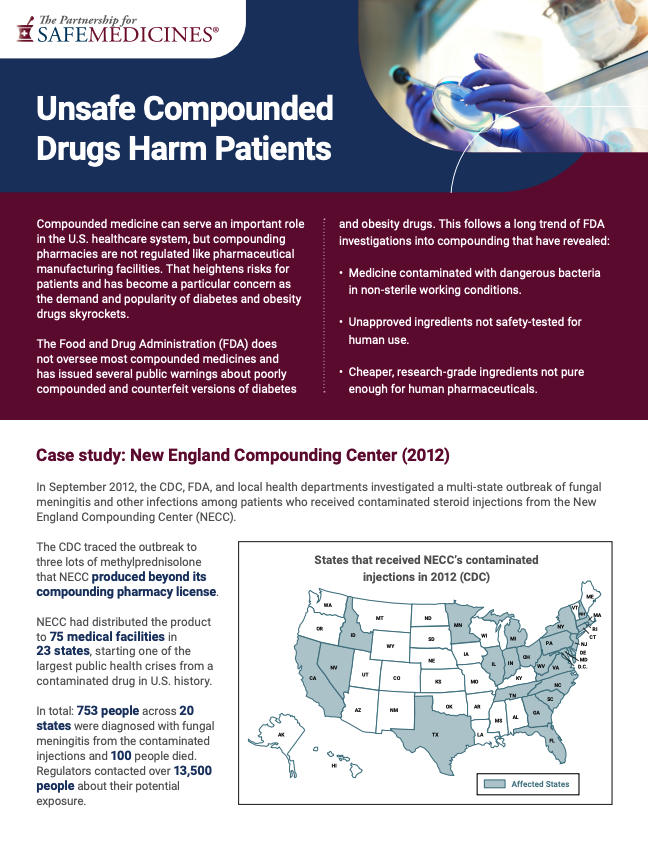
Learn more about the harms that unsafe compounding may cause here.
Domestic
A survey reveals that one in ten people are harmed by medications bought online. An article explores how a company has evaded regulatory accountability when advertising compounded medications.
A report from the Michigan State University Center for Anti-Counterfeiting and Product Protection found that one in five consumers in an eight-nation survey unknowingly purchased fake drugs, and an additional one in four reported doing so intentionally. The survey also found that one in ten participants who bought medications online experienced direct harm from them. These products are often bought through online pharmacies and social media, and many consumers remain overconfident in their ability to identify them.
An article from Drug Discovery & Development explores the regulatory gray area in which Medvi operates. In February 2026, the company received a warning letter from the FDA for misleading claims, but the company has no direct regulatory accountability because of its role as a marketing and technology subsidiary that outsources its prescribing and pharmacy services. Medvi also faced scrutiny for deceptive tactics like testimonials allegedly generated by AI, raising concerns under the Federal Trade Commission’s advertising authority. The article argues that fragmented oversight across agencies has enabled similar companies to scale rapidly, which shows the need for stronger, coordinated regulation.

The FDA has proposed new legislation that would strengthen its authority to penalize misleading direct-to-consumer drug ads by formally classifying certain violations as “misbranding.” The proposal, which also targets advertising for compounding drugs, requires clearer disclosures that these products are not FDA-approved.
The FDA issued a final order debarring Kimberly Schaff Kiehl for 10 years from importing drugs into the United States following her felony convictions related to trafficking counterfeit and misbranded pharmaceuticals.
A Pennsylvania woman died after taking tianeptine or “gas station heroin,” an addictive, opioid-like substance that remains easily available and legal in several states, including Pennsylvania, despite FDA warnings.
Regulators protecting patients in the news
The FDA issued a warning letter to Intas Pharmaceuticals in March 2026, citing serious manufacturing violations, including inadequate investigations into failing drug quality results and significant data integrity lapses in electronic batch records, rendering products potentially adulterated. The letter references a 2024 recall of tablets, likely r the cancer medication cinacalcet or the thyroid medication levothyroxine sodium, both of which Intas recalled that year.
The FDA also issued a warning letter to Lexia LLC after an inspection found major violations, including inadequate drug testing and a lack of stability data, with a company representative reportedly describing the product’s expiration dating as “anecdotal.” The FDA concluded that these deficiencies could render the products adulterated and raise serious concerns about their safety, quality, and effectiveness.
The FDA issued a warning letter to Foshan Miwei Cosmetics Co., Ltd., citing violations including inadequate product testing, lack of stability studies, and weak supplier and quality control systems, leading to concerns that its products were adulterated. The agency also determined that several sunscreen products were unapproved new drugs and misbranded due to improper labeling and missing required safety directions, resulting in import restrictions.
International
Separate stories about an unregulated prescription drug network and the conviction of counterfeit pill makers in the U.K. Fake Diludid in Canada. More news in India and South Africa.
A U.K. Medicines and Healthcare products Regulatory Agency (MHRA) investigation uncovered a £1.8 million illegal network distributing unregulated prescription medicines, including drugs like modafinil, tamoxifen, and finasteride, which were being sold online and by mail order without authorization. Seven men were convicted for operating the scheme, which involved large-scale storage, packaging, and distribution of unsafe prescription drugs.
Three more U.K. men were convicted after police uncovered a £3.35 million illegal drug operation that used an industrial unit to mass-produce counterfeit prescription-style pills, including powerful sedatives like etizolam and fake Xanax tablets. Surveillance and raids revealed a “professional” pill-making setup producing tens of thousands of dangerous drugs for street sale, leading to prison sentences for the ringleaders.
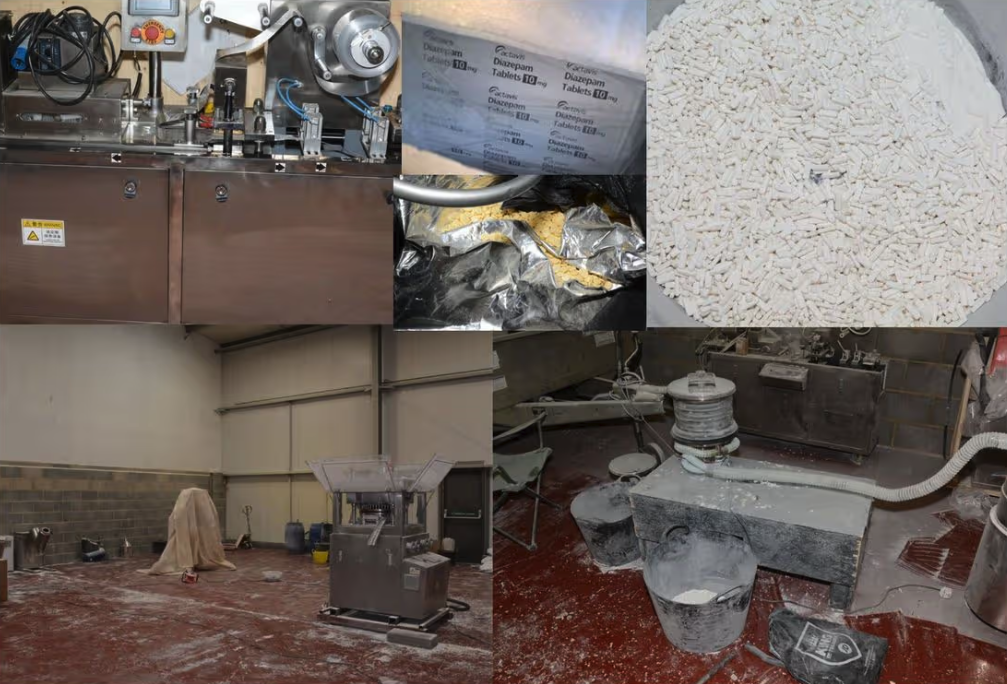
(Photo: Humberside Police)
The Royal Canadian Mounted Police in Newfoundland and Labrador issued a warning after seizing counterfeit Diludid pills made with a highly potent synthetic opioid.
Police in Nagpur, India, uncovered a counterfeit medicines racket involving a pharma unit and multiple distributors who were allegedly producing and selling fake versions of the drug Alburel across several cities, leading to criminal charges and an ongoing investigation.
Authorities in Delhi, India, raided an unlicensed pharmacy, seizing over 100 types of medicines, including antibiotics and expired drugs, after confirming illegal sales through a decoy operation. The investigation found the shop continued operating without a valid licence after its cancellation in 2024, and legal action has been initiated.
Police in South Africa seized counterfeit goods worth about R900,000, including fake medicines, during a multi-agency operation that also led to drug arrests and immigration-related detentions.