
May 18, 2026: FDA warns 503B compounding pharmacy for producing tirzepatide after shortage ended
Major Stories

Read FDA's warning letter
The FDA issued a warning letter to ProRx, citing its production of tirzepatide, which is not eligible for compounding. The Food, Drug, and Cosmetics Act allows for compounding using bulk drug ingredients only if the drug is on the agency's “503B bulks list” or the drug shortage list. Tirzepatide was never listed on the 503B bulks list, and has not been in shortage since 2024. The FDA also found the firm’s sterile drug production to be unsanitary, its products to have labeling issues, and its adverse events reporting procedures to be inadequate.
The FDA sent this letter shortly before the agency’s April 30 proposal to exclude three weight loss drugs, including tirzepatide, from the 503B bulks list, “finding no clinical need for outsourcing facilities to compound these drugs from bulk substances.” ProRx and, reportedly, BPI Labs ceased producing these drugs in April, while Medisource stopped in March after its parent company, Hims, decided to cease sales of compounded semaglutide.
As compounders respond to tightening regulations around tirzepatide, a surge in counterfeit and black market versions of the drug may fill the gap. Americans should keep in mind that the safe source for weight loss and diabetes injectables is licensed U.S. pharmacies.
Domestic
The State Department moves to impose sanctions against an online pharmacy that sold fentanyl. Customs in Philadelphia intercepted 32,000 counterfeit pills. News about pill press operations in Florida, Louisiana, and New York.
The U.S. Department of State announced it’s taking steps to impose visa restrictions on 13 people associated with KS International Traders, a company that the agency describes as a sanctioned online pharmacy that generated revenue through fentanyl trafficking.
Customs and Border Protection officers in Philadelphia say they seized 32,000 counterfeit pills that were smuggled from Europe in April. According to reports, at least 17,000 of the pills were labeled tramadol, and other tablets were labeled as lorazepam, zolpidem, diazepam, and alprazolam. The packages were addressed for Georgia, and labeled as “XOMETRY” and “100 X TSHIRT (GIFT)” to avoid scrutiny.

Photo: CBP Philadelphia.
A Chicago woman was sentenced to 12 months of imprisonment and 3 years of supervised release on charges related to a drug trafficking and diversion organization. According to court documents, members of the group flew into Montana, presented fake prescriptions to pharmacies in the state, fraudulently obtaining controlled substances, including oxycodone.
Three men living in Hong Kong were charged with international narcotics trafficking on the dark web. Between November 2021 and June 2022, two defendants allegedly recruited people to assist in reshipping narcotics online and, with the third defendant, coordinated shipments of thousands of pills from Hong Kong to the U.S.
Pill presses

Photo: U.S. Attorney's Office, Southern District of Florida
A Chinese national and a Nevada man were charged with importing large amounts of the synthetic opioid protonitazene. According to court records, the men coordinated the procurement and shipment of the drug from China to co-conspirators in Florida who would use pill presses to manufacture counterfeit pills. According to the Justice Department, China’s Ministry of Public Security arrested the shipper and a coconspirator and seized packages being shipped to U.S. recipients.
A Louisiana woman was sentenced to 30 years in state prison in connection with a clandestine pill laboratory. After detectives received a tip stemming from a video call, a search of her residence led to the discovery of pill presses, binding agents, and stolen prescription medication obtained through her employment at a care facility. Investigators discovered her counting counterfeit M30 fentanyl tablets at her kitchen table in the presence of her minor children.
In New York, a warrant led law enforcement officers to an industrial-scale pill-pressing operation in a Manhattan apartment. Court documents say that investigators found a pill press and 37 pounds of methamphetamine hidden behind panels inside a closet.
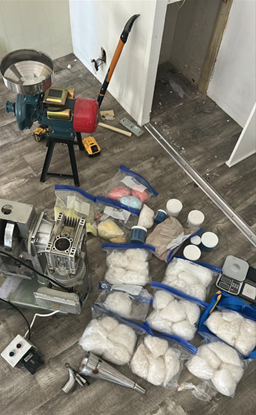
Photo: U.S. Attorney's Office, Southern District of New York
Regulators protecting patients in the news

Pharmacal Eczema Cream. Photo: FDA
The FDA posted three recalls last week. Sun Pharma voluntarily recalled 675 vials of DOXOrubicin Hydrochloride Liposome Injection with the lot number HAG2581B. The firm detected glass particles in some vials during production, which could pose severe risks to patients. The injection is indicated for Ovarian cancer, AIDS Related Kaposi Sarcoma, and Multiple Myeloma.
Pharmacal issued a recall of one lot of Multi-symptom Treatment Cream & Skin Protectant Eczema Cream after the product was found to be contaminated with Staphylococcus aureus, which can cause severe skin infections for those with compromised skin.
XD Investments LLC recalled 448 boxes of Better Weather Fix Elixir products due to undeclared pharmaceutical ingredients. The products contain Mitragynine and Mitragynine Pseudoindoxyl, the latter of which is also called Kratom, which the FDA has warned consumers not to take.
In addition to the ProRX warning letter, the FDA warned a Korean manufacturing facility of over-the-counter drug products for insanitary conditions, including what the FDA says appeared to be an insect floating in an unidentified substance. The firm was also warned for not adequately testing raw materials for the presence of volatile impurities.
The agency also warned an Israeli company producing saline products and a New York company producing antioxidant supplements for marketing unapproved new drugs meant to treat medical conditions.

Better Weather Fix Elixir. Photo: FDA
Legislation
The Health Subcommittee of the House Committee on Energy and Commerce passed an amended version of the Destruction of Hazardous Imports Act (H.R. 2715) by voice vote. The bill would provide the FDA with authority to order the destruction of imported merchandise that poses significant risks to public health.
Ohio legislators introduced HB 890, which would establish a prescription drug affordability board (PDAB) with upper payment limit authority.
In Minnesota, HB 5156 and SB 5302 were introduced. They would require health plans and pharmacy benefit managers to report financial information to the state's PDAB upon request.
Keep up with state legislation in the areas of pill presses, prescription drug affordability boards, drug importation, and med spas.
Legislation

This Reddit post describes a patient who lost nearly 60 pounds using compounded semaglutide before developing severe nausea, chest pain, projectile vomiting, and ultimately liver failure that required emergency care and months of recovery. The poster said they followed dosing instructions and had regular contact with online providers, but later realized they had little direct medical oversight or routine lab monitoring while taking a powerful injectable medication.
Their experience highlights patient safety concerns around compounded GLP-1 drugs: inconsistent quality control, unclear sourcing, potential contamination, dosing errors, and delayed recognition of serious adverse effects. As access to these medications expands through telehealth and online marketing, experts continue to stress the importance of physician supervision, regular bloodwork, and seeking care immediately when symptoms escalate beyond the “normal” side effects often discussed online.
International
Australian doctors warned against “backyard” peptides, sharing experiences of severe complications linked to these products. Europol supported an international operation to take down a counterfeit medication network. Nigerian regulators shut down illegal pharmacies and warned about counterfeit Augmentin.
An article in The Age reported a sharp rise in Australians being hospitalized after using illegal or unregulated peptides promoted online for weight loss, muscle building, anti-aging, and skin improvement. Doctors described patients arriving with severe vomiting, chest pain, heart attack symptoms, dangerous infections, and complications linked to contaminated “backyard” products, with some cases requiring skin grafts or amputations. The article also revealed that authorities were investigating a death linked to growth-stimulating peptides.
Europol supported an international operation targeting a criminal network that produced, distributed, and sold counterfeit medicines and supplements. The organization, which spanned six countries and operated for almost 20 years, generated at least € 240 million (over $278 million) in illicit transactions. At least nine people were arrested, and assets worth at least €17.7 million were seized. Almost 200 websites were blocked in Romania, and machinery to produce the counterfeits was found.
Nigerian regulators intensified efforts to combat counterfeit and unsafe medicines, shutting down 1,550 illegal pharmacies and medicine outlets across the country in early 2026. The crackdown comes amid growing concerns about fake drugs and unlicensed vendors, highlighted by a recent warning from the National Agency for Food and Drug Administration and Control about counterfeit Augmentin antibiotics circulating in the country.
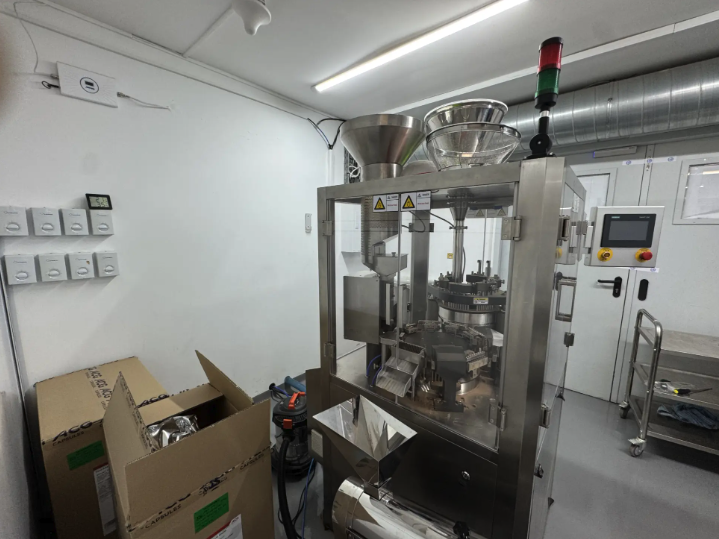
Photo: Europol