
December 7, 2025: More fake Ozempic pens found in the U.S. supply chain
The U.S. Food and Drug Administration (FDA) announced the seizure of dozens of units of counterfeit Ozempic 1mg injection pens labeled with an authentic lot number, PAR1229, but displaying the expiration and lot numbers for the product in the wrong place. Neither Novo Nordisk nor the FDA can confirm the contents or quality of the counterfeit product. Learn more here.

Watch our video about these new Ozempic fakes.
PSM published a new resource detailing recent crime around black market HIV medicines. Read it here.

More news about GLP-1s
Connecticut Attorney General William Tong sent cease and desist letters to weight loss spas in Avon, Brookfield, and Danbury for advertising non-FDA-approved compounded GLP-1 weight loss drugs. Tong noted that “there are currently no generic GLP-1 weight loss injections on the market, and anyone advertising or offering this is not telling the truth and exposing patients to potentially unsafe bootleg drugs.”
Cullman, Alabama-based Aurora IV & Wellness agreed to surrender its license and stop practicing medicine to settle a lawsuit with the state of Alabama over treating patients with research-grade GLP-1s. A lawyer representing the patients said they had experienced severe headaches, nausea, and welts near injection sites.
Authorities are also making decisions about false advertising around GLP-1s:
- The Federal Trade Commission approved a final order against a second telehealth company, NextMed, that would require them to stop deceptive advertising of their weight-loss programs, as well as unfair billing and cancellation practices.
- BBB National Programs, an industry self-regulation group, concluded that telehealth provider Willow Health could not use published studies about Novo Nordisk’s FDA-approved semaglutide products to substantiate health claims about its own products, which involve different active ingredients, formulations, and methods of administration.
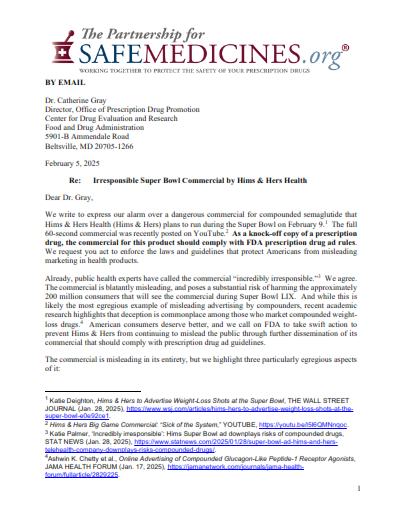
PSM wrote FDA about a misleading GLP-1 ad aired during the Super Bowl in February 2025.
Domestic News
Scammers in Mumbai sold Americans fake drugs. Two more men were sentenced for selling secondhand HIV medicines. An independent pharmacy chain in West Virginia is closing because of under-reimbursement.
Police in Mumbai, India, arrested eight people and shut down a fraudulent center that sold U.S. resident medicines like Viagra, Cialis, and tramadol, using fake websites to collect payments, and either delivering counterfeit drugs or not delivering medicines at all. Police say that scammers illegally acquired Americans’ private data and posed as representatives of U.S. pharmaceutical companies to make the sales. Authorities are still investigating the scale of the operation.
Miami, Florida, residents Boris Arencibia and Jose Armando Rivera Garcia received 57-month prison sentences for their roles in a conspiracy that collected and used fake distribution companies to resell prescription medicines with false paperwork to pharmacies across the country. Some unsuspecting patients received bottles that contained the wrong medicine or even pebbles. Arencibia and Rivera Garcia were changed in two cases, pleading guilty to money laundering in the first, and to trafficking in medical products with falsified documentation in the second.
The Today Show interviewed a woman who was deceived into buying a fake product for lipedema after seeing an ad that sported a deepfake video of her own doctor promoting it.
A Washington state resident pleaded guilty to reshipping tens of thousands of prescription drugs to U.S. buyers who ordered them from a drug organization based overseas.
West Virginia-based Fruth Pharmacies announced that it would be shutting down. The chain’s owner attributed the closure to pharmacy benefit managers reimbursing pharmacies less than it costs them to acquire medicine for their patients. Matt Rafa, the president of West Virginia's pharmacists association, said that Fruth’s closure would exacerbate the problem of pharmacy deserts that leave rural customers without local care.

The University of Southern California’s Pharmacy Access Initiative has developed a tool to identify pharmacy deserts across the country. Check it out at pharmacydeserts.com.
The Drug Enforcement Administration reported that federal drug enforcement agents had seized two dozen pill press machines in October.
Thomas Taylor of Cleveland, Ohio, was sentenced to 17 and a half years in prison after pleading guilty to charges related to his management of a pill press operation that distributed thousands of fentanyl pills throughout Ohio. Agents seized firearms, cash, equipment, and kilogram quantities of illicit drugs during the investigation.
Police in Scott County, Kentucky, seized a pill press and suspected cocaine after a high-speed chase involving a rental vehicle.
Regulators protecting patients in the news
The FDA warned consumers about fraudulent products such as bodybuilding drugs that may cause heart attack, stroke, and liver damage, and Ayurvedic supplements found to contain toxic heavy metals.
The agency also posted warning letters to:
- a 503B outsourcing facility in Arkansas for serious sterility concerns, including mold in an area where syringes of cancer drugs were being prepared;
- a second 503B in Florida for unsanitary conditions and other current good manufacturing violations, some of which affected lots of antibiotic eye drops and semaglutide injections; and
- a Utah-based testing laboratory for inadequate investigation of microbial contamination.
Prescription drug affordability boards
Last week’s update on prescription drug affordability board activity summarizes October meetings in Colorado, where board members set a date for implementation of an upper price limit on Enbrel, and Oregon, which continued to review medicines to determine their affordability for residents.
Legislation
The Massachusetts House of Representatives is considering H4489, which would empower the state’s Health Policy Commission to recommend measures to reduce the cost of drugs that have seen five years of price hikes. The bill is a revision of an earlier bill, H1092, which was introduced in February.
A second Massachusetts bill, H4493, aims for PBM reform, including stopping under-reimbursement of pharmacies.
International News
British authorities haven’t shut down an illegal GLP-1 manufacturer that was raided in October.
The Guardian noted that Alluvi Healthcare Limited, a U.K. business that the MHRA raided in October for selling counterfeit, unlicensed retatrutide and tirzepatide pens, was still selling them via Telegram and its website.
Authorities in Puducherry, India, warned that officers had seized 34 different kinds of counterfeit medicines, including medicines for diabetes, high blood pressure, asthma, and COPD, antibiotics, and antihistamines.
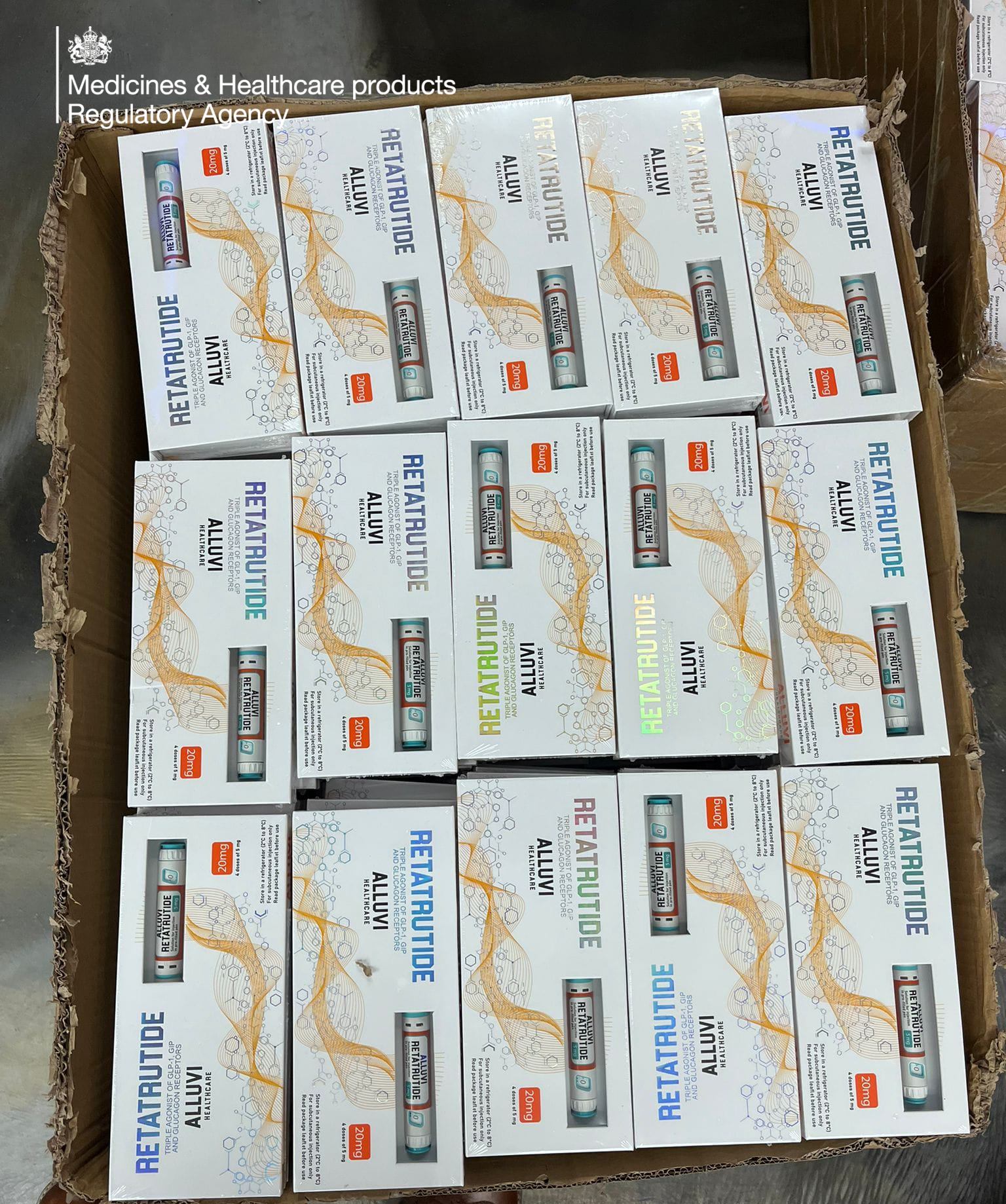
Retatrutide pens seized in an illicit factory in Northampton, U.K., October 2025