
January 20, 2026: PSM research leads Google to enforce its pill press ad policy
Major Stories
Reporting on PSM-led research led Google to suppress pill press ads, Congressman Raja Krishnamoorthi sent letters to shippers of weight loss drugs and API, and a former nurse was charged with distributing counterfeit Ozempic.
In July 2025, Google announced that it would update its “dangerous products or services” policy to ban advertisements for pill presses, a move that we applauded. We monitored the implementation of this ban, which was set to take effect in September 2025, and found that vendors were still selling the machines as late as January 2026. When MassLive reporter Hadley Barndollar contacted Google about the lack of compliance, the company investigated and took down the ads and pill press listings on Google Shopping. You can read more about our monitoring here and read MassLive’s coverage, as well as Barndollar’s award-winning series of pill press stories, which were published in 2024
Congressman Raja Krishnamoorthi announced that he sent formal letters to three Chinese biotechnology companies demanding information about their manufacturing, labeling, and export of GLP-1 drugs and APIs that may be unlawfully entering the U.S. drug supply. The letters seek detailed disclosures about product lists, U.S. customers, and regulatory compliance, with responses due by January 31, 2026. Congressman Krishnamoorthi cited concerns that unregulated drugs are being used to make compounded injectable weight-loss drugs falsely marketed as substitutes for FDA-approved medications. Our Freight Fraud report, where we have reported suspicious shipments from the companies that received Krishnamoorthi letters, echoes these sentiments.
A former Chicago, Illinois, nurse was charged in federal court with distributing counterfeit Ozempic to patients, according to prosecutors. Authorities allege that the woman falsely labeled the drugs as Ozempic, even though they were not made by Novo Nordisk and did not contain the active ingredient semaglutide. A registered nurse at the time of the incident, she was not authorized to prescribe or dispense Ozempic. She has pleaded not guilty ahead of a status hearing set for February 3, 2026.

Read PSM's post about pill press ads slipping through despite Google's policy change.
Domestic
A dive into the DIY weight loss gray market, unapproved weight loss drugs side effects, and a guilty plea from a xylazine supplier.
A New York Post article explored the growing “peptide gray market,” where Americans are buying weight loss drugs, Botox, and fillers directly from Chinese suppliers and administering them at home. Drawn by prices that are “90% cheaper” than treatments found through the legitimate supply chain, users share tutorials on social media platforms, often using products labeled “not for human use.” “You can just type everything into Chat GPT — you don’t really need a doctor,” Ashley, a California user, opined, while another participant described the trend as “Temu for medicine.”
Bunnie Xo, the wife of country star Jelly Roll, revealed she experienced severe depression and suicidal thoughts after taking retatrutide, a weight loss drug that is still in clinical trials. Since the drug is not FDA-approved, it was not obtained through the legitimate pharmaceutical supply chain, and its safety, quality, and dosing could not be independently verified.
A Florida-based veterinary supply company pleaded guilty to illegally distributing the veterinary sedative xylazine and was ordered to forfeit more than $748,000 in profits. Prosecutors said All Veterinary Supply, Inc. sold nearly 181,000 bottles of xylazine outside the scope of its permit, allowing the drug to enter the illicit drug supply and contribute to overdose deaths.
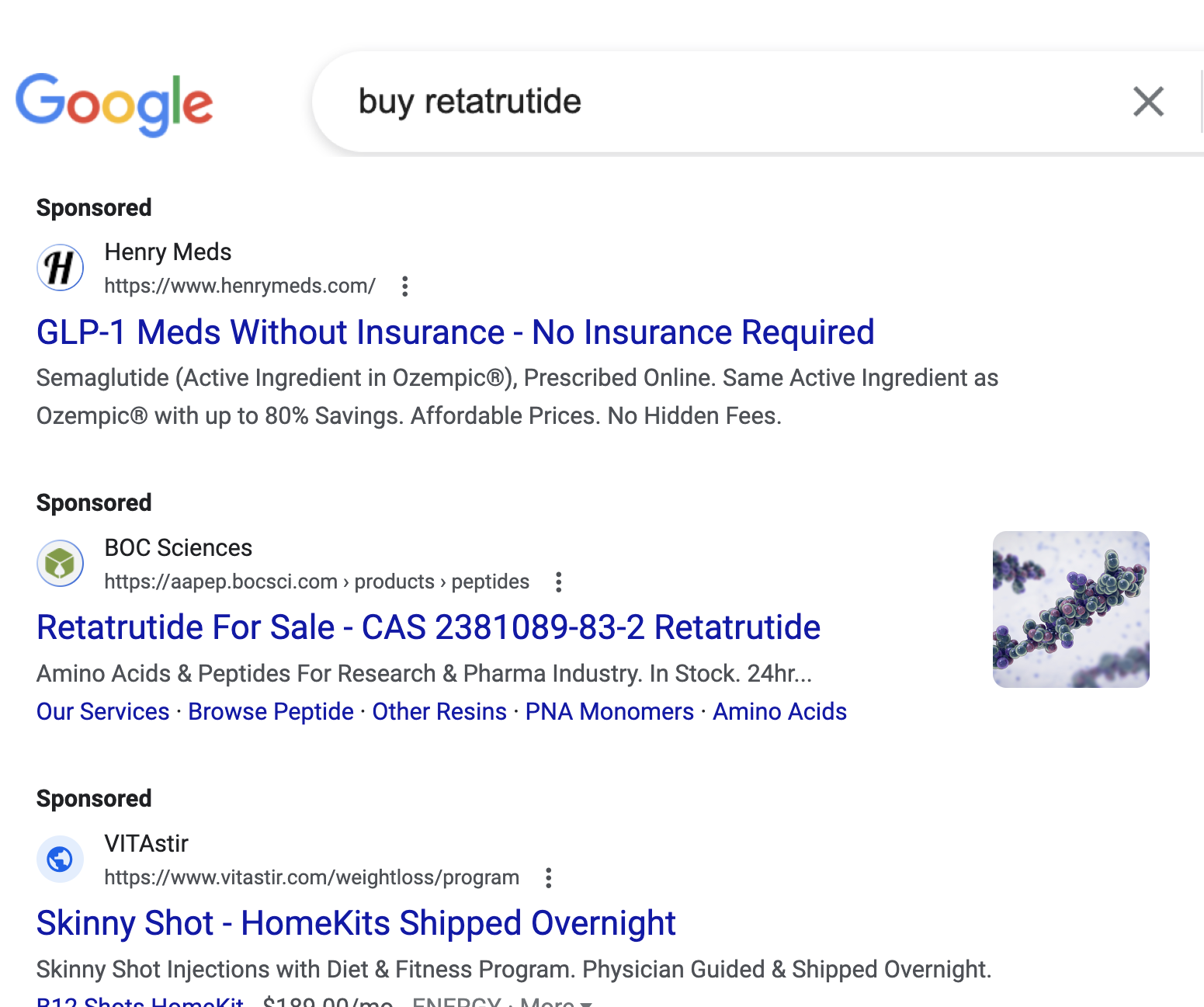
As these October 2023 google search results show, gray market distributors are already selling retatrutide even though it hasn't left clinical trials.
Pill presses
A Massachusetts man pleaded guilty to possession with intent to distribute 500 grams or more of methamphetamine and wire fraud in federal court in connection with an investigation into counterfeit pills containing fentanyl and methamphetamine. Pill press molds, multiple pill presses, and records showing the purchase of numerous pill presses and parts were seized during the investigation.
San Francisco police seized over 4.5 pounds of drugs, including meth, fentanyl, and cocaine, and arrested four men at a suspected Oakland, California drug house. Officers also confiscated drug-making equipment, including pill press molds, ammunition, and cash during the search.
Two people were arrested after an investigation uncovered a fentanyl pill manufacturing operation in Texas. After one suspect was caught selling fentanyl pills in a controlled buy, evidence led investigators to a large-scale production site where they seized a commercial-grade pill press, precursor chemicals, finished fentanyl pills, and multiple controlled substances.

Close up of a pill press seized during the Oppenheimer investigation (U.S. Attorney's Office, District of Massachusetts)
Regulators protecting patients in the news
The FDA issued a warning letter to an Indian API manufacturing facility, citing testing and insurance documentation failures that were repeated violations from past inspections.
They also issued a warning letter to a Georgia-based manufacturer over poor building maintenance and inadequate maintenance and cleaning of equipment. Investigators found visible product residue, oxidized metal, and foreign material on equipment and a non-functioning metal detector, which compromised the facility's ability to prevent contamination. Notably, investigators found a metal screw in a sealed bottle.
Legislation
Virginia HB 483 and SB 271 would establish a prescription drug affordability board to conduct affordability reviews and set upper payment limits (UPLs) for certain drugs under state-regulated health plans. The Board must set UPLs in line with the federal maximum fair price for applicable drugs. Virginia’s governor has already vetoed two bills that would have created a PDAB in the state.
Illinois SB 0066 would create the Health Care Availability and Access Board, which would review drugs and determine whether to impose a UPL. The UPL, should it be set, also must be equal to the Medicare Maximum Fair Price.
Georgia HB 931 would establish a prescription drug affordability board in Georgia that would conduct affordability reviews and have the power to set a UPL.
Kansas SB 212 would establish a prescription drug affordability board and a stakeholder council to review prescription drug prices and set UPLs for certain high-cost drugs.
In South Carolina SB 0825 would establish a prescription drug affordability committee to address drug costs and make recommendations to reduce state and patient spending. The committee would not have the ability to set a UPL, but could recommend it as a policy recommendation to the legislature.
Colorado HB 1056 would allow self-insured employers to use pharmacy stewardship and prescription drug importation programs to reduce costs. The bill establishes disclosure requirements, recognizes pharmacy stewardship as a cost-containment tool, and outlines enforcement and applicability provisions.
Florida SB860 would regulate compounded medications for weight loss by requiring that any sale, transfer, or distribution of such drugs be accompanied by documentation verifying that the active pharmaceutical ingredients are FDA-approved, pharmaceutical-grade, and properly tested.
Keep up with state legislation in the areas of pill presses, prescription drug affordability boards, drug importation, and med spas.

Many state legislatures are considering upper payment limits set by prescription drug affordability boards (PDABs) to improve medicine affordability for their residents. Read this handout to learn why isn't a good solution and catch up on our PDAB coverage here.
International
A lidocaine toxicity death in Canada highlights regulatory gaps in med spa oversight; fake drugs found in India.
A Toronto Star investigation found that a woman’s 2020 death from lidocaine toxicity at an Ontario beauty clinic highlights serious gaps in oversight of medical spas, where prescription anesthetics and cosmetic procedures are often administered without proper medical supervision. Loosely enforced rules allow clinics to “rent” medical directors who are rarely on-site, enabling unqualified staff to perform potentially dangerous procedures. Experts warn that this regulatory gray area has led to a surge in unsupervised treatments and are urging stricter requirements to protect patient safety.
Telangana drug officials seized counterfeit “Levipil 500” anti-epileptic tablets in Hyderabad that falsely claimed to be manufactured by Sun Pharma.
Authorities in Zirakpur sealed a fake medicine factory after a joint police and regulatory raid uncovered large-scale illegal drug manufacturing tablets, injections, and cough syrup under unsafe and unhygienic conditions.
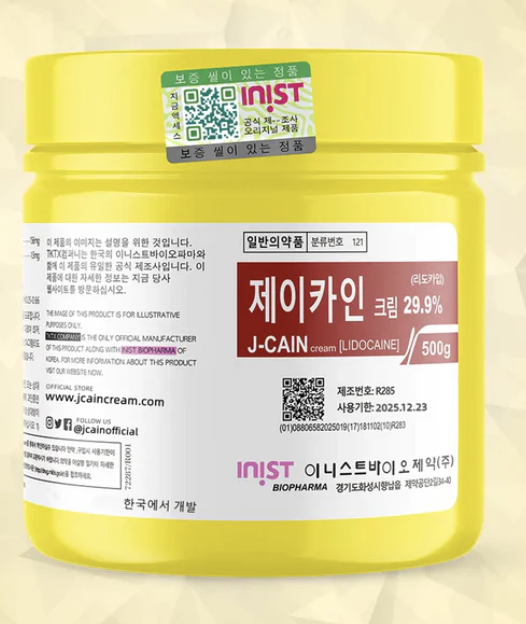
The U.S. FDA warned consumers about companies selling products like this one, that contained dangerous levels of lidocaine, in April 2024.