
PSM applauds Indiana legislature's compounding and med spa reform
March 3, 2026
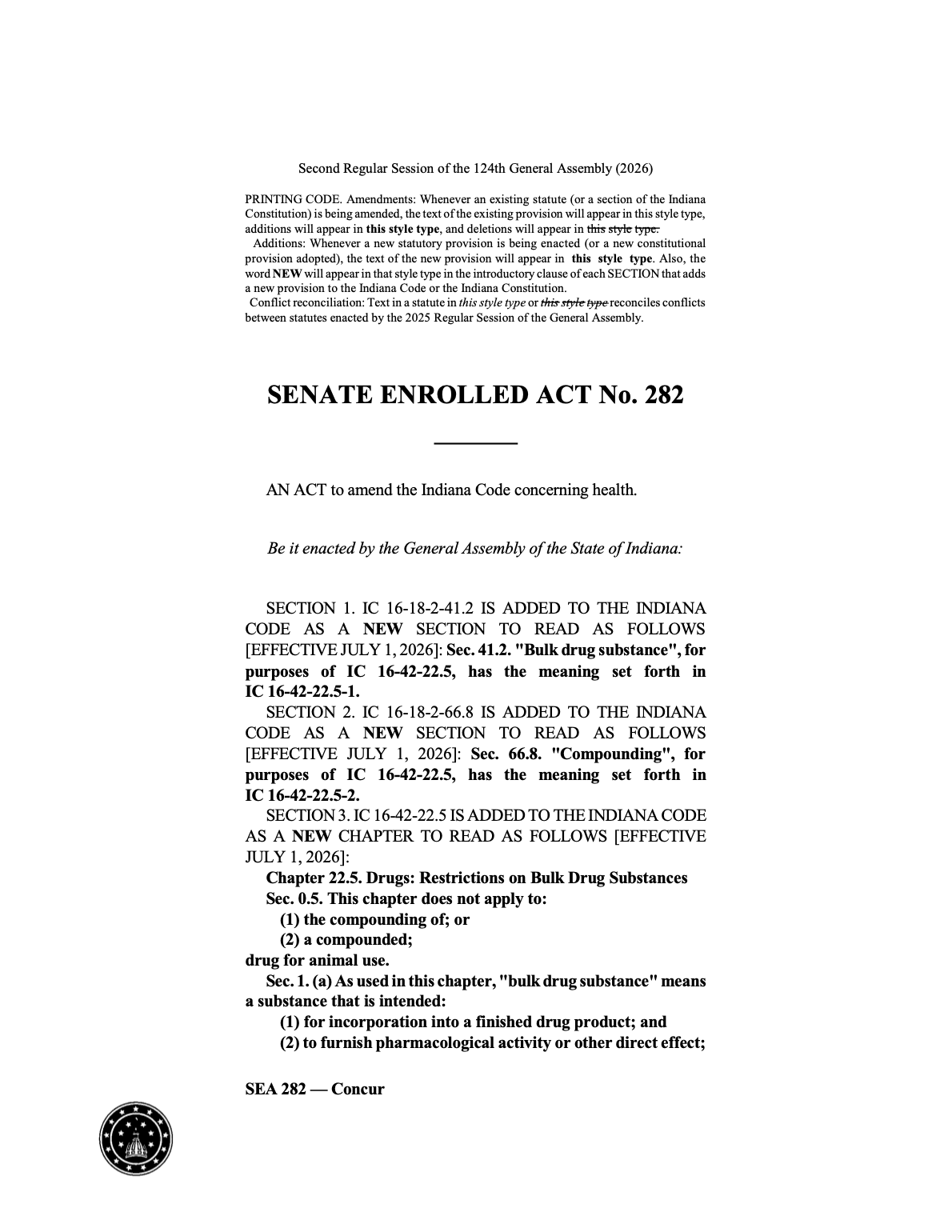
On February 26, 2026, PSM was glad to see the Indiana legislature pass SB 282, a bill that strengthens compounding and medical spa regulation to keep Indiana patients safer.
Compounding ingredient safety
Why compounding ingredient safety regulation?
PSM’s Fishy Freight report and the Food and Drug Administration’s published concerns about unsafe GLP-1 API makers indicate that we’re seeing quite a bit of problematic API manufacturing in facilities that never registered with the FDA.
Many compounding ingredients come through a long line of unregulated wholesalers, not all of which are regulated by the FDA. When a compounder purchases a GLP-1 API from an FDA-registered wholesaler, it may be difficult to ascertain which FDA-registered manufacturer made it. Additionally, USP and USP-NF haven’t published technical specifications for every GLP-1, so there isn’t always a standard available to judge the quality of compounding API.
What does SB 282 do?
The new law requires compounding pharmacists and physicians to:
- use quality-tested bulk drug substances made for humans, at FDA-registered sites, shipped with a certificate of analysis identifying them and the country in which they were made, and
- compound them in compliance with the Food, Drug, and Cosmetic Act and any applicable chapter of the United States Pharmacopeia (USP).
SB 282 also establishes record keeping requirements so that anyone selling, transferring, or distributing compounded drugs must keep related records two years after compounded drugs containing the substance have expired.
Finally, it tasks the Indiana board of pharmacy with investigating the sourcing, labeling, handling and compounding of these drugs, and requires its state department to produce an annual oversight report on drug compounding that includes a summary of deficiencies and violations, investigations, and disciplinary actions.
Where could it go farther to protect patient safety?
Earlier texts of the bill would have required specified impurity testing details on certificates of analysis so that you could see, for example, that the ingredients did not have problematic amounts of impurities like arsenic.
We’d also like to see the original FDA manufacturer appear on the certificate. To be compliant with federal law, the ingredients have to come from an FDA-registered manufacturer. Today, the compounder takes the word of the wholesaler that this is true. We’d like to see them be able to verify that by knowing the original manufacturer. SB 282 only requires it to reveal the country of origin.
Medical spa regulation
Why med spa regulation?
As we’ve seen in both Ohio and New York state, med spas are a source of great patient endangerment. Investigations in both states have revealed troubling practices such as purchasing counterfeit products, dispensing unapproved medicines, and even doing a little light illegal compounding.
What does SB 282 do?
The law mandates that medical spas (facilities treating, compounding and/or dispensing medicine for weight loss, wellness, longevity, or cosmetic treatments) register with the Medical Licensing Board of Indiana by January 1, 2027 and sets a fine of up to $5,000 for unregistered med spa sites.
As part of this registration process, spas must:
- identify a licensed responsible practitioner (a physician, advanced practice registered nurse, or a physician assistant) with prescriptive authority
- have the responsible practitioner physically present often enough to ensure that employees are appropriately licensed and trained,
- limit their treatments to their offices except for training purposes, and
- notify the board of serious adverse events (death, life threatening medical event, or hospitalization within 15 days.
The medical board may investigate violations of these rules and refer licensed practitioners to their governing boards, and may suspend registrations for deceptive or misleading advertising. It will also maintain a public database of every registered medical spa.
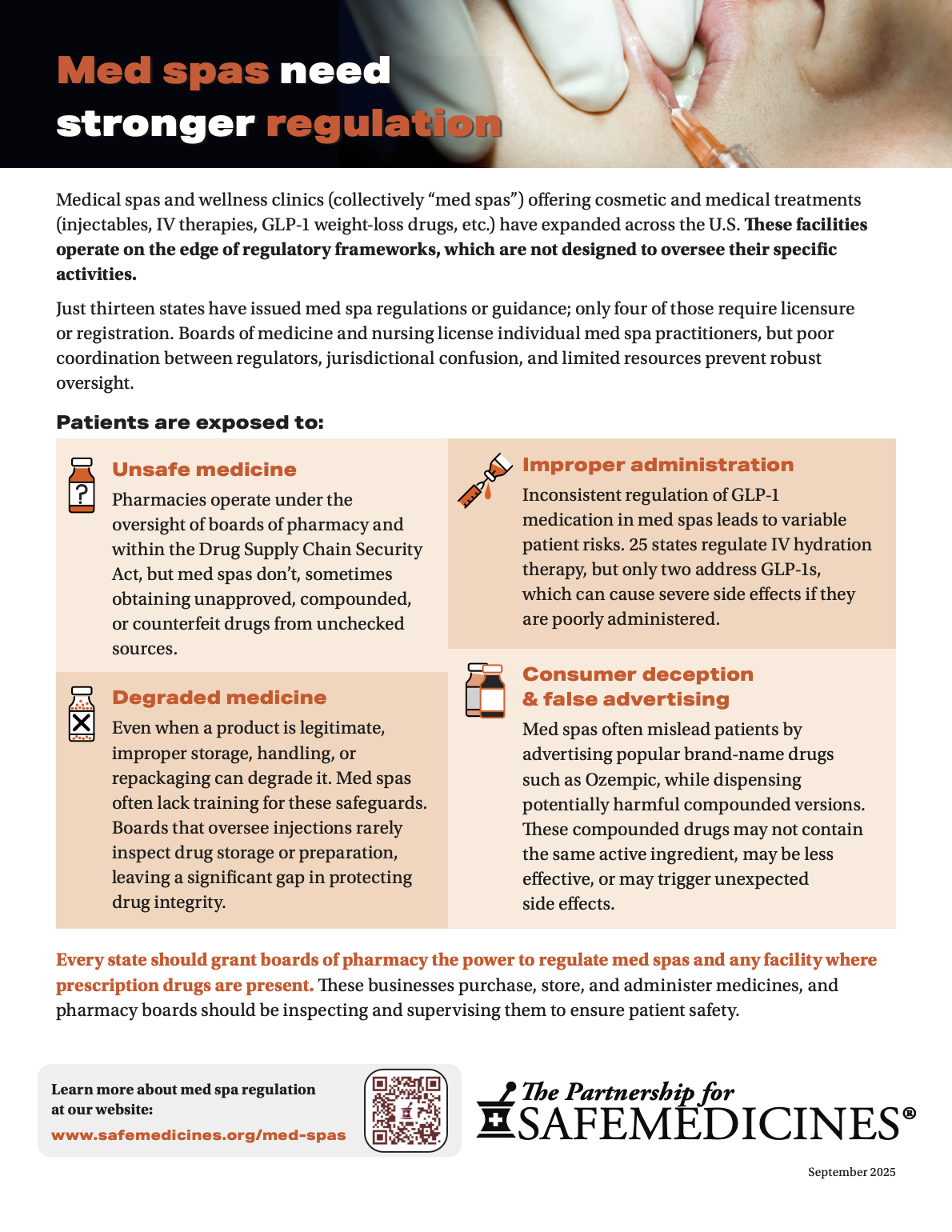
Indiana's legislation is a much needed step toward stronger regulation of medical spas.
Where could it go farther to protect patient safety?
SB 282 exempted physician-owned practices. This is probably what it took to get it over the finish line politically, and we’re strong believers in improving safety incrementally and not waiting for the perfect bill.
But given the history of cosmetic physicians buying non-FDA-approved medicines and illegally compounding, we’d like to see the Indiana Board of Pharmacy have the right to go anywhere prescription medicines exist, including physician-owned practices.
SB 282 only requires that a “responsible practitioner” be physically present at a med spa long enough to ensure that the business is complying with regulations. In an industry where patients have been injured in medical spas where unqualified doctors are “supervising” remotely, it would be safer to require that a doctor, advanced practice nurse, or physician’s assistant be on site whenever clients were being treated.
PSM’s assessment
SB 282 is a good tool to help compounding med spas, pharmacies, and medical practices identify safer suppliers, and new record-keeping requirements should allow investigators to track the source of medicine safety issues. These provisions offer a better framework for protecting patients from upstream suppliers that may sell substandard or counterfeit API, and give Indiana’s board of pharmacy stronger oversight of compounding across the state.
We also appreciate SB 282’s establishment of registration for medical spas, which firmly places med spas under the control of the state medical board, helps regulators understand where med spas are operating, and offers clients a way to choose reputable businesses.
PSM applauds Indiana’s efforts to protect residents from dangerous compounding ingredients and unregulated med spas. SB 282 provides a strong base for improved patient safety in the state.