
Pharmacists beware: Diverted HIV medicines are being sold on online pharmacy-to-pharmacy platforms
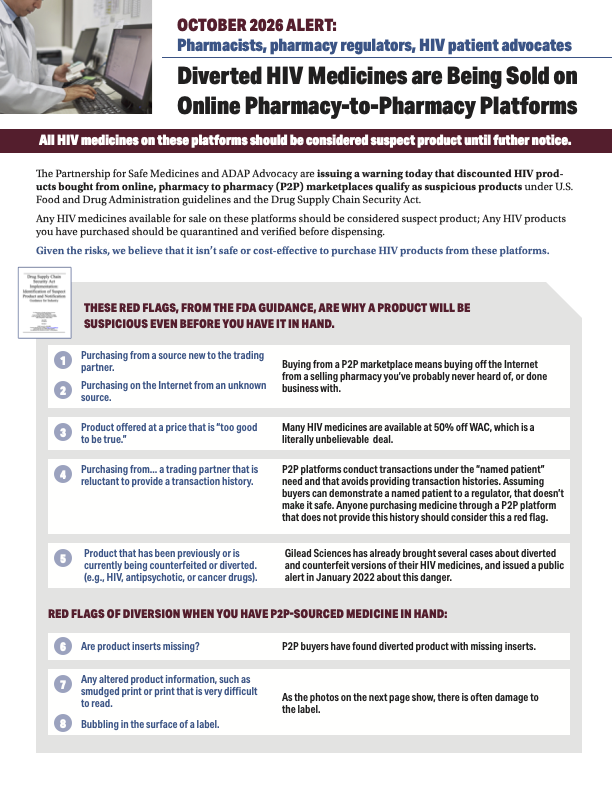
All HIV medicines on these platforms should be considered suspect product. Product purchased from these platforms still in inventory should be quarantined and investigated.
June 30, 2026
Summary
The Partnership for Safe Medicines and ADAP Advocacy are issuing a warning today that discounted HIV products bought from online, pharmacy-to-pharmacy (P2P) marketplaces qualify as suspicious products under U.S. Food and Drug Administration guidelines and the Drug Supply Chain Security Act.
Any HIV medicines available for sale on these platforms or any medicine you have bought and not yet dispensed should be considered a suspect product; any HIV products bought through these channels in your possession should be quarantined and verified before dispensing.
Given the risks, we believe that it isn’t safe or cost-effective to purchase HIV products from these platforms.
Recommendations for products with known counterfeit or fraudulent activity
- Pharmacists should cease buying HIV medicines from these platforms and quarantine and verify all medicine in inventory obtained from them.
- Boards of Pharmacy should study this alert and consider warning their licensees about the danger of purchasing HIV medicines from these platforms.
- P2P platforms should disallow sales of HIV medicines on their platform.
Background
In April, Gilead Sciences filed a Lanham Act suit against ten pharmacies and 15 individuals for allegedly selling diverted HIV/AIDS medicines to pharmacies across the nation via online P2P marketplaces. (Note that this case has just been filed and no admission or finding of guilt has been made. The defendants in the Pain Relief Rx case should be presumed innocent until these claims have been adjudicated.)
This is reminiscent of other civil litigation Gilead Sciences has filed in the name of patient protection. Gilead Sciences v Pain Relief Rx et al is similar to Gilead Sciences v Safe Chain Solutions et al (2021), and Gilead Sciences v Peter Khaim et al (2024), the latter of which also involved the sale of unsafe medicine via P2P sales. Those cases led to criminal prosecutions of major players. A full analysis of how civil litigation becomes criminal litigation can be found in “Leveraging the Lanham Act for Anti-Counterfeiting: A Case Study of Gilead Sciences’ Successful Civil-to-Criminal Enforcement Strategy in the U.S. Pharmaceutical Market.”
In the Safe Chain and Khaim cases, defendants collected bottles of medicine from patients, removed identifying information, filled and resealed them, forged pedigrees and slipped them back into the legitimate drug supply via distributors like Safe Chain Solutions.
In the most recent case against Pain Relief Rx et al, Gilead asserts that the defendants obtained medication that had previously been dispensed to patients and resold it as new through P2P platforms to pharmacies around the country.
A deeply discounted product qualifies as suspect even before the purchasing pharmacy receives it because the listing alone meets many of the U.S. Food and Drug Administration’s (FDA) risk criteria for illegitimacy: deep discounts, an established pattern of fraud in the HIV drug supply chain over the last six years, unknown sellers, and incomplete transaction histories. Once received, the often-observed damage to the packaging confirms that this product will need to be quarantined and investigated.
For a look at images of illegitimate product obtained by Gilead Sciences, see our case page for Gilead Sciences vs. Pain Relief RX et al.
Patients in need of assistance with their HIV medications are encouraged to explore the following resources:
- AIDS Drug Assistance Program (ADAP) - ADAP Advocacy's ADAP Directory is a convenient online resource for locating AIDS Drug Assistance Program information across all US states and territories.
- TotalAssist Program - Patient Advocate Foundation and PAN Foundation announced a strategic merger to create TotalAssist Program, the nation’s most comprehensive nonprofit dedicated to helping people navigate, access, and afford care.
- HarborPath - HarborPath is a non-profit that delivers life-saving medication to the uninsured.
- HealthWell Foundation - HealthWell Foundation is a leading independent non-profit dedicated to improving access to health care for America’s underinsured.
- RxAssist - RxAssist can help you learn how to use pharmaceutical company programs and other resources to reduce your medication costs.
Questions and answers for pharmacists
Which sales platforms are vulnerable to this criminal activity?
The current suit alleges that defendants sold “diverted, misbranded, infringing, and counterfeit Gilead-branded HIV medicines,” on InStockRx, Rxeed, Rx-Post, and RxWorld, but there are other P2P platforms, among them CityRx, EzriRx, MatchRX, RedSail RxMarket, StockMeds, MedMartRX, and TradeNetRx.
Independent pharmacies have also been known to trade stock in less formal settings such as What’sApp or Telegram. Those transactions are, if anything, more vulnerable and never advisable.
How does this affect dispensers who use these platforms?
Online P2P marketplaces claim to help pharmacies with inventory management, but they historically carry a high risk of suspicious product sales. Dispensers have an obligation to quarantine and investigate suspect products and report them to the FDA and trading partners within 24 hours, if they prove to be illegitimate. Below, we show how you would evaluate both the listing and the purchased product in the Gilead Sciences case as suspect.
Analysis of a suspect product from Gilead Sciences v. Pain Relief RX et al.
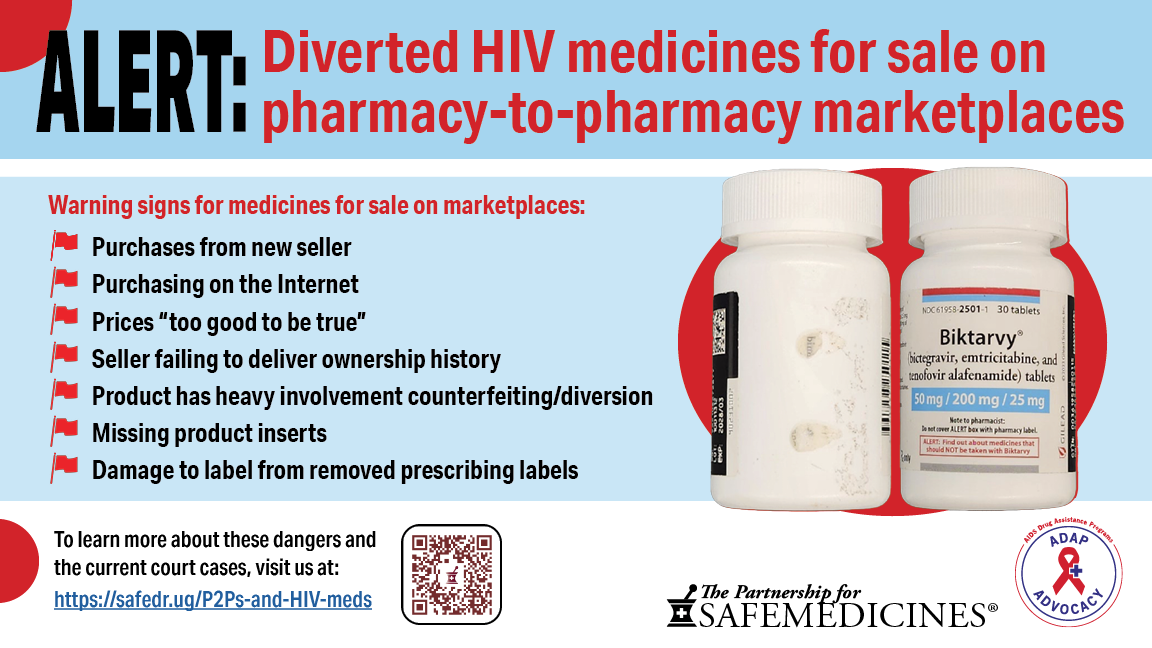
In December 2025, a pharmacist searched the P2P marketplace RxPost for Gilead’s products, Biktarvy and Descovy, and found listings advertising them both at $1,999 and $1,099 respectively. That is a discount of roughly 53% and 50% off the Wholesale Acquisition Price (WAC), significantly below what you would pay if purchasing it from an authorized prime wholesaler. Upon receiving the product there were signs it had been previously dispensed to a patient. The medical outsert was missing, and the label was damaged, with sticky residue and smearing consistent with use of a solvent to remove a prescribing label.
While it’s possible it had a prescribing label attached and was removed because a patient didn’t pick it up, it’s also possible it was dispensed to a patient and then purchased back from them and rerouted into the supply chain illegally.
Even before purchasing, the listing on the P2P marketplace would qualify as a suspicious product.
While reviewing the listing on the P2P marketplace, a purchasing pharmacist would use the elements identified on pages 7-9 of the FDA guidance to determine that these products were suspect even before buying them.
| Criteria | Note |
| Purchasing from a source new to the trading partner. | The trading partner in this case isn’t the Internet P2P marketplace RxPost, because they aren’t a licensed trading partner.
Pain Relief Rx, a pharmacy in Queens, NY is the trading partner and would be unknown to almost all potential buyers on the platform. |
| Purchasing on the Internet from an unknown source. | |
| Product offered at a price that is “too good to be true.” | Even if you consider WAC an inaccurate measure of pricing, at 50% off WAC, $1,999 is still an unbelievable deal |
| Purchasing from a source that a trading partner knows or has reason to believe has engaged in questionable business practices that could increase the risk of suspect product entering the supply chain, such as: A trading partner that is reluctant to provide a transaction history associated with the product being purchased | P2P platforms conduct transactions under the "named patient" need and that avoids providing transaction histories. Assuming buyers can demonstrate a named patient to a regulator, that doesn't make it safe. Anyone purchasing medicine through a P2P platform that does not provide this history should consider this a red flag. |
| Product that has been previously or is currently being counterfeited or diverted (e.g., HIV, antipsychotic, or cancer drugs). | Gilead Sciences has already brought several cases about diverted and counterfeit versions of their HIV medicines, and issued a public alert in January 2022 about this danger. |
While FDA does not offer a specific number of criteria that qualifies a product as suspicious, five seems to be sufficient for any reasonable person to determine it is so.
Once in possession, the product itself would have additional red flags and require quarantine and verification.
Once the purchasing pharmacy has custody of the product, FDA’s guidance says that trading partners like pharmacies “must have systems in place that enable them, upon determining that a product in their possession or control is suspect, to quarantine suspect product and promptly conduct an investigation.”
A pharmacy would use these strategies to determine that a product is suspect and requires quarantine and verification.
| Criteria | Notes from Gilead’s filing |
| Closely examine the package and the transport container … Seeing if product inserts are missing | “...the bottle of BIKTARVY® was missing its outsert” |
Closely examine the label on the package, and the label on the individual retail unit, if applicable, for:
|
“... the bottle’s original label had dots of lifted ink and a torn corner consistent with the removal of a pharmacy-applied patient label; the text on the variable-print area of the bottle was blurry and smeared, consistent with the use of a solvent to remove a pharmacy-applied patient label and clean the bottle.”
This damage would be visible in photos of the product on the sale listing on RxPost before purchasing. |
What does it mean to quarantine and verify a product?
Quarantining is the easy part.
FDA’s December 2023 guidance on verification systems directs trading partners in possession of suspect product to:
- Physically separate suspect products from verified sources,
- Update database records to ensure the suspect products aren’t further distributed, and
- Assign a responsible person (such as the pharmacist-in-charge) to terminate the quarantine once the medicine has been verified.
Verifying / investigating is the hard part.
In short: there is no suspect product that is cheap enough that it is worth it for a community pharmacy to conduct a full investigation. This is why you don’t want to buy suspect product.
FDA guidance documents indicate that you must “promptly conduct an investigation, in coordination with the manufacturer and other trading partners, as applicable, to determine whether a suspect product is illegitimate.” As part of the investigation, someone will need to verify the DSCSA data on the package, the transaction information, and the transaction history. How you work that out with the manufacturer who is going to actively participate in the investigation is certainly subject to discussion.
The guidance from the FDA says that the elements of your verification process should include:
- Validation of transaction history and transaction information; and
- Active communication with the manufacturer and trading partners.
In practice, this means that you will be:
- Asking the P2P marketplace seller where they bought the product they sold to you, and confirming that fact with their supplier; and
- Communicating the information you have with the manufacturer and comparing notes. They will also have information about where the product went when they sold it into the wholesale chain which may reveal fraud.
How do you reach a manufacturer? There is always contact information for manufacturers and repackagers in a product’s transaction history, or on the product packaging. If not, check company websites for contact information. It is sometimes listed as the phone number to contact for quality and safety concerns.
If this all seems like a lot, you understand why we think you should avoid purchasing HIV medicines from P2P marketplaces at this time. All HIV medicines for sale from these marketplaces should be considered suspect products.
States have different requirements regarding when dispensers must notify their boards of pharmacy about illegitimate products. Check local regulations.
Is the seller required by the DSCSA to disclose the seller they purchased it from?
All P2P transactions are conducted under a DSCSA exemption, which makes the P2P platform statements that they are “DSCSA compliant” both misleading and meaningless to patient safety.
However, there is no exception in the law for product verification investigations. If you request that a seller provide you verification because you have determined their product is suspect, they must provide you the information about where they purchased it from.