
Prescription Drug Freight Fraud, June 2026 report
Over the past year, our freight fraud investigations have documented a rapidly evolving pipeline of pharmaceutical imports tied to increasing demand for weight loss and wellness drugs. In previous reports, we identified kilogram-scale shipments of semaglutide and tirzepatide entering the United States from unregistered manufacturers, including residential addresses, hotels, homeopathic clinics, and other implausible facilities. Many of those shipments were released into the U.S. supply chain despite obvious red flags.
Our data from March and April 2026 shows some of those trends have continued, but federal regulators are beginning to enforce fraud more effectively.
Read more:
Knockoff weight loss drugs from illegal foreign sources (PSM report, March 2025)
Review previous updates on our pharmaceutical border security page
Our methodology
To conduct this analysis, we reviewed the FDA’s import records and cross-referenced shipment information against FDA registration databases, ITACS manifest records, and FDA product-code classifications. We also reviewed manufacturer addresses and shipment descriptions to identify facilities that do not appear consistent with legitimate pharmaceutical manufacturing activity.
For March and April 2026, we examined semaglutide, tirzepatide, antidiabetic, and antibiotic product categories to identify shipments tied to unregistered facilities, product-code mismatches, active pharmaceutical ingredient imports, and shipments intended for compounding.
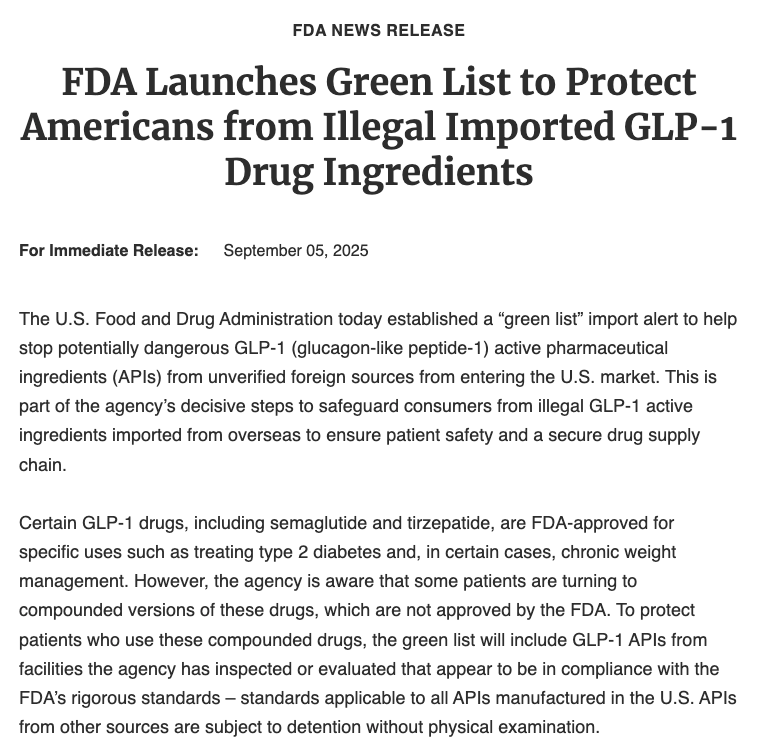
Six months into the “green list” era
In September 2025, the FDA launched an import enforcement framework targeting foreign-sourced weight loss active pharmaceutical ingredients used in compounding. Under the policy, foreign semaglutide and tirzepatide API shipments could be detained without physical examination unless they came from manufacturers the FDA had reviewed and added to the agency’s “green list.”
The March and April 2026 data suggest that the increased FDA scrutiny is altering the behavior of illicit importers. By making the raw API channel hostile to unvetted labs, the FDA has successfully squeezed bad actors, forcing them to resort to alternate customs declarations to evade detection.
The high-level view: surging volume
On the surface, the high-level metrics point to a structural shift: despite a massive 56.6% surge in total semaglutide and tirzepatide shipments (climbing from 474 to 837), the volume of illicit attempts grew more slowly, rising from 71 to 86 shipments. Consequently, the overall proportion of illegitimate shipments in the pipeline fell from 14.98% to 10.27%.

API Analysis
When looking strictly at raw materials, the green list has forced illegitimate API shippers to resort to hiding their shipments. Declared illegitimate shipments plummeted from 25 down to just 4.

This data exposes an encouraging reality: the FDA's policy has effectively stripped unregistered foreign labs of the ability to declare their cargo honestly as raw API.
However, this data also exposes a probable pivot by bad actors. Total illegitimate shipments still ticked up slightly (from 71 to 86), while unregistered API numbers plummeted, revealing the agility of illicit networks. Because the FDA closed the API door, almost all illegitimate shipments now avoid the API classification. Bad actors may have simply stopped declaring their cargo as raw materials to avoid automatic green list filters, opting instead to mislabel their freight as finished drug products, or hide them under alternative customs codes like the generic "antidiabetics" category.
What still slips through
While the green list altered how cargo is declared, final physical enforcement execution at the border is still an immense operational hurdle. Before the green list, federal inspectors refused 4.6% of total illegitimate shipments. In March and April 2026, however, that interception rate fell to just over 1%. The breakdown for semaglutide is especially alarming: out of 32 identified illegitimate shipments, only 2 were refused entry.
Furthermore, while the system is successfully catching and forcing a pivot among smaller players, gaps still remain at the industrial scale. Most notably, two massive tirzepatide shipments from Taixing SynTheAll Pharmaceutical Co., an illegitimate facility in China, declared 204 kilograms and 214 kilograms of API, and both shipments were released into the United States. Because these bulk quantities contain the equivalent of millions of individual doses, even a single enforcement failure at this scale introduces massive systemic risk to public safety.
Ultimately, these numbers do not suggest that FDA oversight is failing. In many respects, the exact opposite is true: regulatory pressure is working precisely as intended, successfully flattening the curve of obvious trafficking and cleaning up the raw material supply chain. What the data illustrates is simply the immense operational game of whack-a-mole facing the agency.
Experimental drugs emerging as the next challenge
One of the clearest trends in the March and April 2026 data was the appearance of unapproved, investigational obesity and diabetes drugs quietly entering the country under the generic “antidiabetics n.e.c (not elsewhere classified)” product code.
The most significant example was retatrutide, Eli Lilly’s experimental obesity and diabetes treatment that has not yet been submitted for FDA approval. Our analysis flagged six retatrutide shipments from unregistered manufacturers, most of which were released into the United States. The five released were investigational API shipments from Changzhou Sta Life Science Co Limited in China. The refused shipment came from an Australian compounding pharmacy.
The appearance of retatrutide in import data likely reflects growing demand for next-generation obesity drugs before they have even completed the approval process. To be clear, the only safe way to consume retatrutide is through an Eli Lilly clinical trial. All other sellers of the compound are black market, illegal sellers.
The emergence of these compounds presents a difficult challenge for regulators. Unlike semaglutide and tirzepatide, where the FDA has now spent years responding to shortages, compounding, and illicit imports, many of these newer drugs are still investigational. Public awareness, online demand, and black market sourcing are accelerating faster than existing enforcement systems were designed to handle.
Some trends persist
Among semaglutide and tirzepatide shipments, we identified imports tied to residential addresses, standard retail pharmacies, mailing storefronts, compounding pharmacies abroad, and even construction businesses.

One listed “Mail Boxes” in the United Kingdom before ultimately being refused as an unapproved new drug.
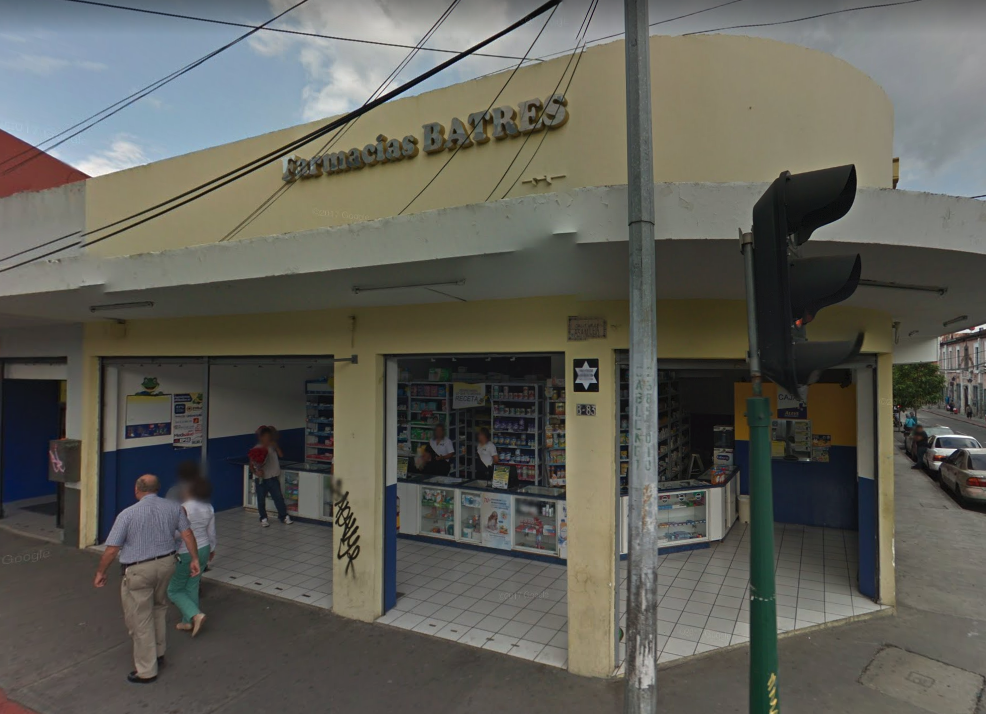
Another originated from a standard pharmacy chain in Guatemala.

One shipment listed a Calgary mailbox retail location as the manufacturer.

One shipment identified a London Heathrow Airport hotel as the manufacturer.
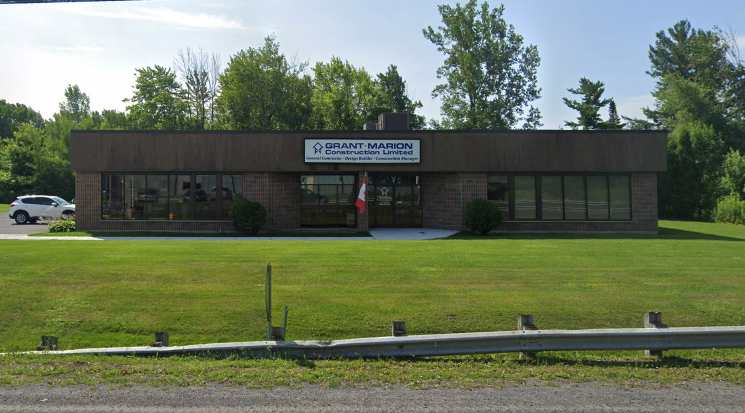
We identified a shipment with an address of a construction company listed under an individual’s name.
Usually, these shipments are small compared to the kilogram-scale imports we documented in earlier reports, but they should still be scrutinized like every other shipment.
Product-code manipulation is still a major vulnerability
Beyond the direct manipulation of GLP-1 identifiers, product-code obfuscation remains one of the most effective techniques used to bypass border security.
Among 434 shipments coded as antibiotics, we identified 118 shipments (27.19%) with ITACS-declared products that did not match their product classifications. Rather than antibiotics, these shipments contained blood pressure medications, diabetes drugs, peptides, and experimental live biotherapeutic capsules.
Only two mismatched shipments were refused.
These discrepancies could be driven by deliberate criminal evasion or systemic manifest negligence by customs brokers, but the practical result is identical: it exposes Americans to unsafe drugs. When nearly 30% of a high-volume category like antibiotics is mislabeled, the agency loses its baseline ability to accurately calculate risk profiles and allocate physical inspection resources effectively.
FDA oversight remains essential
The March and April data also raise broader questions about the limits of current oversight systems.
On May 1, 2026, the FDA sent a warning letter to Harbin Jixianglong Biotech Co., a semaglutide API manufacturer previously included on the agency’s green list. According to the letter, during an on-site investigation, inspectors found that the company purchased semaglutide ingredients from unauthorized suppliers, relabeled imported material as its own product, and failed to maintain adequate manufacturing and contamination controls. FDA ultimately removed the company from the green list, placed it on import alert, and oversaw recalls of semaglutide API batches already distributed in the United States.
This incident offers a vital lesson: the green list framework cannot be treated as a static, self-policing registry. The victory here was not the list itself, but the active enforcement that validated it. Without continuous on-site inspections, warning letters, and immediate import alerts, fraudulent schemes like this would remain invisible, exposing millions of American patients to unverified and potentially contaminated medicine.
Access to our data
PSM makes our shipment-level data available to a group of manufacturer brand protection teams, law enforcement, and regulators.
Our policy recommendations
Short term:
- Required inspection of shipments with an invalid FEI number.
- Continued monitoring and inspections of green list facilities to ensure FDA standards are met.
Medium term:
- FDA should be given the authority to mandate the destruction of violative shipments whose manifest states they were made in non-FDA-registered facilities. Shippers should pay the cost of destruction and present proof of destruction to the FDA.
- FDA and CBP should refuse or detain shipments of medical products whose manifest claims that they were manufactured at a site that is not a registered FDA facility.
Long term:
- CBP should be allowed to process, refuse, detain, and mandate the destruction of shipments that cannot be released because they violate the Food, Drug, and Cosmetic Act. Currently, they can only act on trademark violations and controlled substance violations (through an MOU with the Drug Enforcement Administration). Adding their manpower to the FDA’s will keep Americans safer.