
June 6, 2026: Judge blocks Colorado price cap on Enbrel
Major Stories
A federal judge temporarily blocked Colorado from setting an upper payment limit (UPL) to cap the price on Amgen’s arthritis drug Enbrel. The manufacturer sued the state after the prescription drug affordability board, or PDAB, set the nation's first UPL on Enbrel in October 2025, despite public objections from patient safety advocates and pharmacists. The cap was set to go into effect January 1, 2027.
Denver federal courts Chief Judge Daniel Domenico said Amgen would face significant and irreparable harm because of the price cap, and found that federal patent law likely preempted a state price cap, reported Reuters. He instead suggested the state consider subsidies or negotiations to lower the price.
Read more about why price caps may not lower the cost of prescription drugs for patients in our handout.

Domestic
As unapproved retatrutide and other peptides spread across the US, the panel named to advise the FDA on these drugs draws criticism. Legislative analysis looks into med spas and PBM regulation. Sentencing and settlements in federal cases involving illicit drugs.
A CBS News investigation found that bodegas across New York City are selling peptides, including some that claim to be the experimental drug retatrutide. Retatrutide is in clinical trials and not available or approved for human use. CBS News reported that a bodega employee “[sold retatrutide] to a CBS News reporter for $95. No age verification, no medical questionnaire, no prescription needed.” On the company website, its products are deemed “for research use only,” though this was not stated on the purchased vial. CBS also alleged that certificates of analysis on the website are falsified after talking to the laboratory listed.
Additionally, the Washington Post reported on the dangers of unregulated retatrutide, particularly the drug interaction risks associated with injecting it with other unstudied peptides. Because these are unapproved drugs, little is known about the interactions between notorious peptides available online.
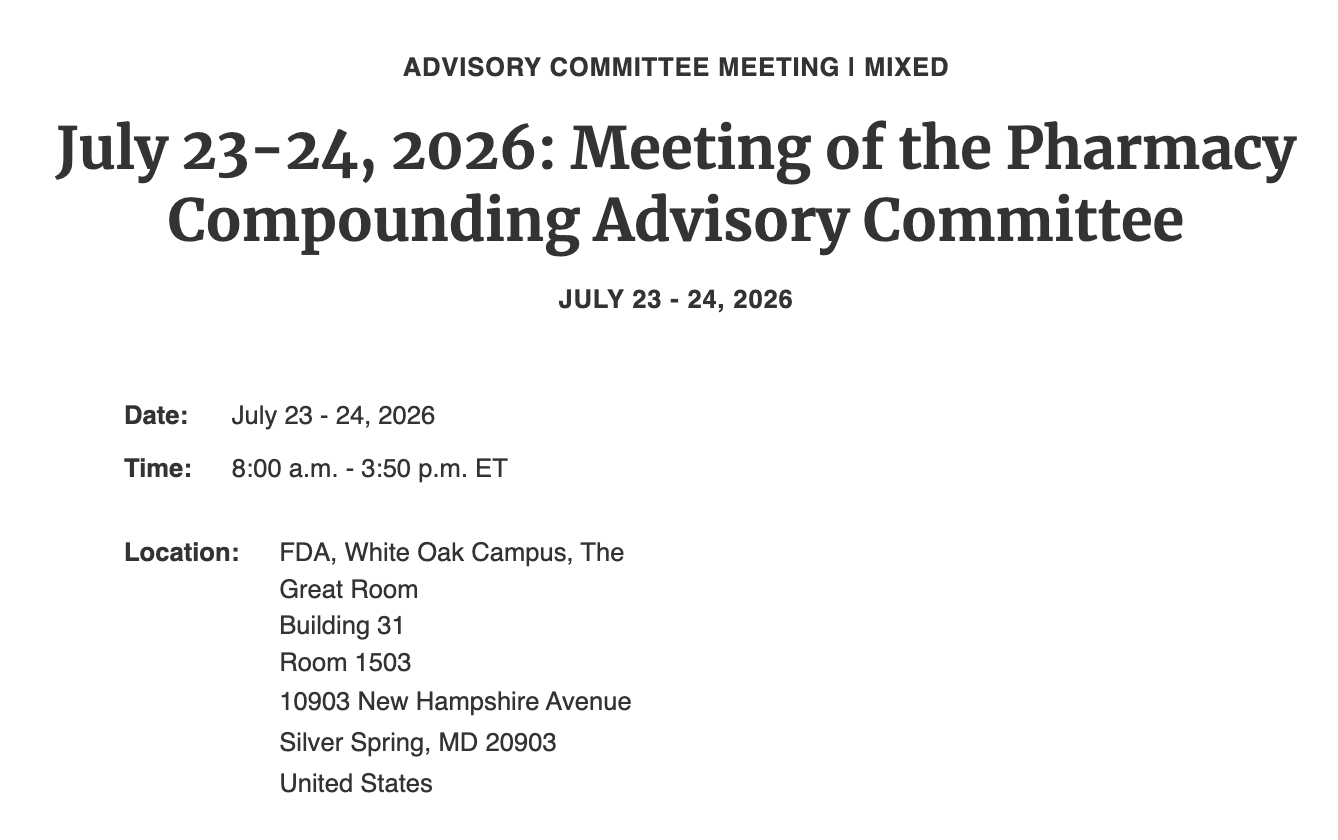
Read our blog about the peptide supply chain risks that we found in Q1 2026 ahead of the PCAC meeting.
The Associated Press reports that the Food and Drug Administration’s (FDA) upcoming July 23-24, 2026, Pharmacy Compounding Advisory Committee meeting to evaluate peptides includes members with professional conflicts of interest. According to AP, the panel includes prescribers and promoters of the very peptides under review. One member offers "peptide and hormone" consultations and promotes multiple unapproved peptides online. Another runs a chain of clinics that states “compounded medications offered through our services are not FDA-approved, and the FDA does not verify their safety.” Tennessee State Senator Bobby Harshbarger, “a pharmacist at his family's business… which sells compounded medications for weight loss, longevity, pain, and other conditions,” is also a panelist. His mother, Rep. Diana Harshbarger, asked Health and Human Services Secretary Robert F. Kennedy for relaxed FDA restrictions on peptides, and his father served four years in prison for substituting an unapproved drug from China for a kidney dialysis drug.
As a part of their A Dose of Disruption series, the Houston Chronicle investigated how the rise of compounded weight loss drugs has transformed the pharmacy industry while exposing significant regulatory challenges. They described Texas-based Empower Pharmacy’s rapid expansion to capitalize on soaring demand for lower-cost alternatives to brand-name medications. The outlet also highlighted concerns that compounded drugs are not FDA-approved, receive less rigorous safety testing, and are produced under an oversight system that has not kept pace with the industry's growth.
A Business Law Today article explained that federal regulators are increasing enforcement against medical spas, making clear that they are subject to the same legal and regulatory standards as other medical practices. It highlighted key compliance risks, including improper sterile compounding, inadequate physician oversight, scope-of-practice violations, and misleading marketing of compounded weight-loss drugs, and emphasized that investors and buyers must conduct thorough regulatory due diligence. PSM has long advocated for stronger medical spa regulation and enforcement, encouraging state Boards of Pharmacies to be explicit in expectations for these clinics in their states.
The Associated Press reported that lawmakers in at least 26 states have introduced more than 120 bills to regulate pharmacy benefit managers, or PBMs, the middlemen of the healthcare system. Proposed bills attempt to regulate multiple parts of this system, including requiring PBMs to pay a minimum dispensing fee or requiring PBMs to pass along discounts they negotiate, rather than keeping any portion for profit. Independent pharmacists have warned that low or negative PBM reimbursements are threatening their ability to stay open, which could cause pharmacy deserts and patient access issues. Learn more about how PBM reimbursement works in our handout here.
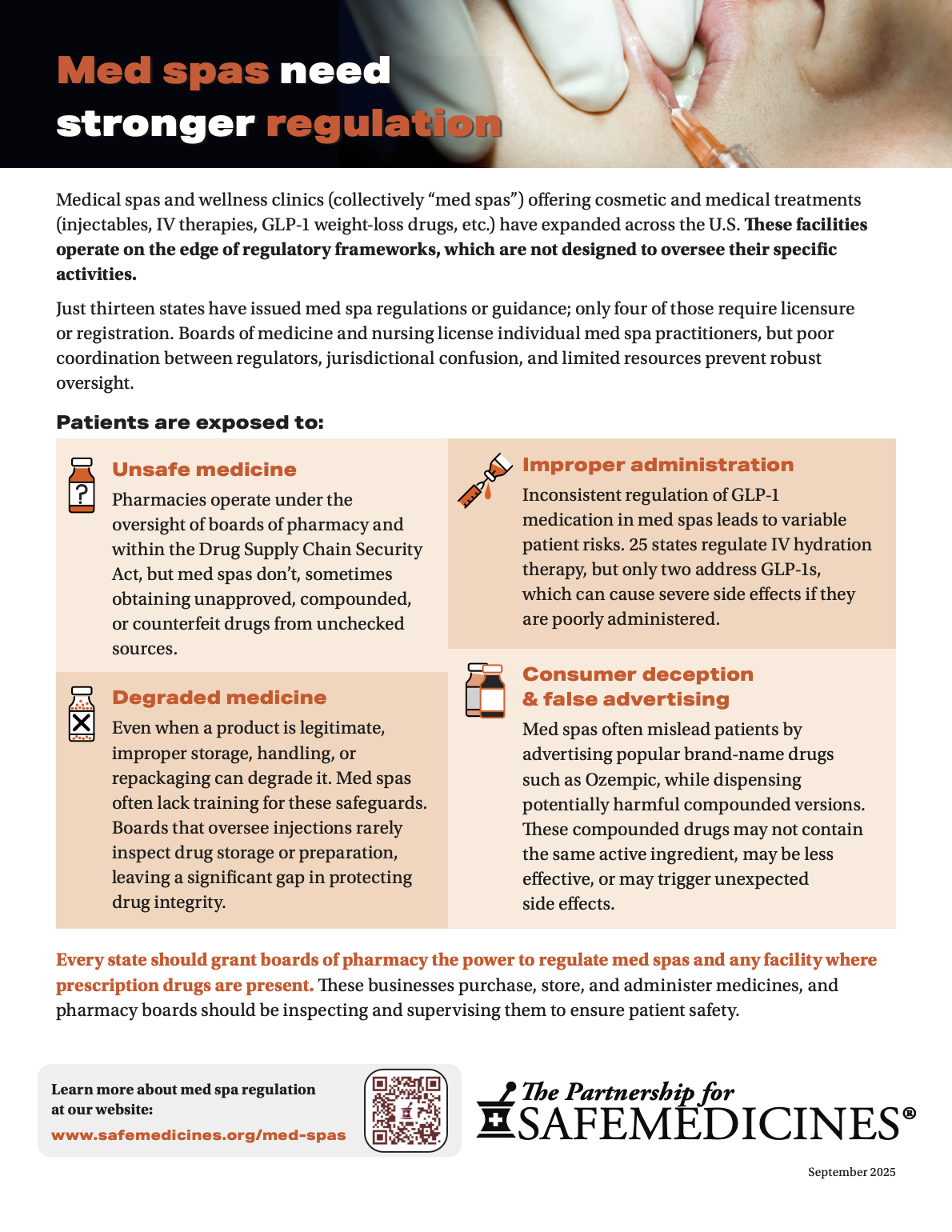
Read more about the regulatory landscape of med spas in our handout.
The Department of Justice (DOJ) announced that a Massachusetts couple was sentenced to prison for importing misbranded drugs from China, repackaging them, and selling them to U.S. customers under the false label "for research purposes only," despite knowing they would be used or injected for performance enhancement and anti-aging purposes. The scheme generated more than $2.5 million in sales and over $600,000 in profits before federal authorities prosecuted the pair.
Alibaba and its payment subsidiary agreed to pay $600 million to settle DOJ allegations that their platform facilitated the sale of illicit medications, precursor chemicals, and counterfeit pill-making equipment between 2016 and 2024. Although neither company will face criminal prosecution, they admitted to compliance failures, agreed to strengthen oversight and anti-money laundering controls, and will continue cooperating with U.S. authorities to prevent the sale of illegal and misbranded drugs through their marketplace.
A California man was sentenced to 10 years in prison for conspiring to sell fentanyl-laced counterfeit oxycodone pills and methamphetamine on the dark web. Prosecutors said he and his co-defendant earned hundreds of thousands of dollars, laundered the proceeds through cryptocurrency, and continued trafficking drugs even after an initial arrest.
Pill press
A Connecticut man was sentenced to 8 years in prison for his role in a scheme to manufacture and traffic counterfeit pills. Investigations revealed that, along with co-conspirators, the man purchased drugs and pill press parts from abroad to press the drugs into counterfeit pills to distribute around the country.
A federal investigation led to the seizure of a pill press and thousands of counterfeit pills after an inmate ran an alleged Indiana drug ring from inside prison.
Regulators protecting patients in the news

The FDA warned an Irish biologics manufacturer for violations involving inadequate oversight over the quality of the drugs, data integrity failures, and incomplete laboratory records. The agency also found that the company failed to conduct thorough investigations into quality issues, raising concerns about the reliability of environmental monitoring data and the integrity of manufacturing records for its biologic products. The warning letter mentioned the company’s organ rejection drugs and Factor VIII to treat hemophilia A.
The FDA cited a French manufacturer of eyedrops for repeated, serious violations involving sterile drug manufacturing, including inadequate investigations into recurring contamination complaints from consumers, poor aseptic practices, deficient facility and equipment maintenance, and ineffective cleaning and sterilization procedures that jeopardized product sterility. The agency also found the company's corrective actions to be ineffective despite similar violations identified during a prior inspection, leading to voluntary recalls of sterile drug products and suspension of certain manufacturing operations.
The FDA cited an Indian manufacturer for extensive violations, including widespread data integrity failures, falsified and incomplete microbiological testing records, inadequate environmental monitoring, and unreliable laboratory documentation that undermined assurance of sterile drug quality. The agency also found major deficiencies in the company's aseptic manufacturing operations, including inadequate cleanroom design, poor contamination controls, insufficient process validation, and poorly maintained equipment with signs of rust and deterioration.
Finally, the FDA cited a Florida manufacturer for dietary supplement violations, including unsanitary manufacturing equipment that could lead to contamination and allergen cross-contact, failure to establish adequate finished product specifications for identity, purity, strength, and composition, and incomplete master manufacturing records. The agency determined that the firm's dietary supplements were adulterated due to these violations.
International
Authorities in Europe and New Zealand warn of the experimental drug retatrutide; authorities in the Maldives have found counterfeit cancer drugs, and counterfeit injectable drugs have been discovered in Myanmar.
A man in the United Kingdom died in 2025 after taking retatrutide, a medication that has not been approved anywhere in the world, according to the Medicines and Healthcare products Regulatory Agency (MHRA) records as reported by The Daily Mail. The drug gained popularity on social media and is often sold on the black market as a “research use only” chemical. That number has already risen to 63 so far in 2026. The outlet reported that MHRA data shows a 350% increase in reported side effects of retatrutide so far in 2026 compared to all 2025 data. The most common adverse event was reported to be gastrointestinal symptoms, but there were also 8 suspected hepatobiliary complications, or symptoms affecting the liver, gallbladder, pancreas, and bile ducts, represented in the data, including the man who died. The outlet also reported a case of acute liver failure so severe, the patient was considered for a transplant before being stabilized.
Any medication claiming to be retatrutide is a black market drug, unless you are getting it through an Eli Lilly clinical trial. Sourcing this medication on the black market risks taking a medication that is not what it claims to be, taking the incorrect dosage, or injecting a drug that is not sterile or free from contaminants. This reporting comes as the chair of Parliament's health and social care committee warned that she has “very little confidence” the MHRA can protect the country against counterfeit drugs. The agency has warned about counterfeit weight loss pills that mimic Wegovy. She cited a lack of resources and powers to meet the already existing demand for these pills as a reason for the lack of confidence.
New Zealand, the Netherlands, and Denmark are also warning of counterfeit retatrutide and other weight loss and peptide products. New Zealand is set to join Australia in its increased scrutiny of peptide products entering the country. The Netherlands warned the public after two people reportedly fell into comas after taking counterfeit weight loss drugs purchased online that contained only insulin. Denmark also reported a massive increase in reported poisonings in the country from counterfeit weight loss drugs.
An Indian man who has been accused of running a counterfeit Mounjaro ring has been denied bail after the scheme was disbanded in April.

Peptides seized by New Zealand Medical Regulators (Photo: Medsafe).
The World Health Organization (WHO) has issued a warning after batches of counterfeit bone marrow cancer treatment were found in the Maldives. The identified batch numbers of Darzalex injections that Janssen said are affected are MYS7381 and STV1K01.
Health regulators in Myanmar are warning of counterfeit Albutein 20% Solution sold in the country. The counterfeit version is incorrectly labeled “IP Specification” and does not display a valid Myanmar drug registration number.