
August 3, 2026: Peptide vendor sentenced to six years for “incredible trail of harm”
Major Stories
A man was sentenced to six years for deceptively marketing “research use only” chemicals, which the judge said left “an incredible trail of harm.” PSM opposed the inclusion of three weight loss drug ingredients for mass compounding, and formalized ties with IPR Center.
A federal judge sentenced the owner of a peptide company to 70 months in prison after he pleaded guilty to selling unapproved drugs, illegally importing products, and misleading customers about their safety and origin. Prosecutors said the company sold research chemicals falsely marketed as high-purity, U.S.-made research products, using forged laboratory certificates to deceive customers. The case is one of the first major criminal prosecutions in the largely unregulated "research use only" peptide market and is being viewed as a warning to other vendors selling unapproved products for human use.
According to prosecutors, some of the products were adulterated with testosterone, contributing to severe adverse effects, including a case of steroid-induced psychosis that devastated one customer's life. The judge cited the company's deception and disregard for repeated regulatory warnings, describing the business as leaving "an incredible trail of harm" for thousands of customers who believed they were purchasing safe, accurately labeled products.

Screenshot from the Paradigm Peptide's website, 2021 (Wayback Machine)

The Partnership for Safe Medicines joined three other organizations to write a letter to the FDA expressing deep support for the exclusion of three weight loss drugs from the 503B bulks list. An explosion in the popularity of semaglutide, tirzepatide, and liraglutide resulted in the compounding of these drugs, which did not end with shortages. These facilities are not subject to the Drug Supply Chain Security Act, and patients are put at risk by unrestricted mass compounding.
PSM and the National Intellectual Property Rights Coordination Center (IPR Center) announced the signing of a Memorandum of Understanding (MOU) to formalize an ongoing collaborative relationship aiming to combat counterfeit and unsafe medications. The MOU will allow the IPR Center and PSM to work together on complex investigations into alternative funding programs and drug importation.

Domestic
State regulators continue to find widespread patient safety issues at med spas, while lacking the authority and resources to adequately investigate the industry. A med spa owner and physician were charged with murder in connection with a 2023 death at their clinic. Customs documents another case of master carton smuggling.
The Atlanta Journal-Constitution reported that a new inspection program by the Georgia Composite Medical Board uncovered widespread patient safety problems at med spas and IV clinics, including unlawful compounding of medications, inadequate physician oversight, and failure to monitor adverse events. State officials are seeking stronger oversight and additional funding, warning that staffing shortages have left the board unable to keep pace with risks that med spas and IV clinics pose to patients. A Washington Post investigation similarly found that most states lack the authority or resources to effectively oversee the rapidly expanding peptide industry, leaving patients vulnerable to unapproved and potentially unsafe products sold through med spas and wellness clinics. Regulators across the country report limited enforcement powers, while experts warned that gaps in federal and state oversight have created an environment where consumers may unknowingly receive untested or mislabeled substances.
This comes as Texas authorities charged a physician and a med spa owner with murder in connection with the 2023 death of a woman who collapsed while receiving an IV infusion at a med spa. Investigators allege the infusion was administered by the spa owner, who was not licensed to practice medicine, while the physician served as the facility's medical director. The National Association of Boards of Pharmacy adopted new model legislation for medical spas to help states strengthen regulation of medical spas and avoid patient harm. The model legislation would authorize boards of pharmacy to license or register facilities that procure, compound, store, dispense, or administer drugs, active pharmaceutical ingredients, controlled substances, chemicals, or peptides, providing states with a framework to improve oversight and better protect patients.
U.S. Customs and Border Protection in Chicago intercepted a shipment from China containing more than 10,000 tablets and 2,100 vials of unapproved medications, including steroids, weight-loss drugs, and medicines for serious conditions such as cancer and thyroid disorders. Officials said the shipment used a "master carton" smuggling scheme, in which multiple pre-labeled packages were concealed inside a single shipment for later distribution across the United States. You can learn more about master carton smuggling in our explainer graphic.
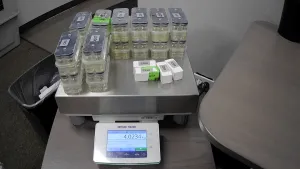
Photo: CBP Chicago
Pharmacists around the country are warning that the FDA's peptide panel’s recent vote supporting six of seven peptides for possible inclusion on the 503A Bulks List does not make those peptides legal to compound or FDA-approved. Any changes must still go through the FDA's formal rulemaking process, which could take months or longer. In a Pharmacy Times article, a pharmacist said he was advising patients not to mistake the advisory vote as evidence that these peptides are safe or effective, noting that many lack robust clinical data and that unregulated "research-use-only" products sold online continue to pose significant risks.
Pill press news
While executing multiple search warrants, Missouri officials seized six pill presses, and Texas investigators seized one pill press in connection with separate drug trafficking and distribution networks. In Ohio, a man was sentenced to over 22 years in prison for his role in an organization that sourced illegal drugs from Mexico, which were distributed around the state. During the investigation into his crimes, authorities seized two pill presses.
PSM in the news
PSM Executive Director Shabbir Imber Safdar joined Fox 5 DC to educate viewers on red flags to help spot counterfeit or substandard weight loss drugs or peptides. He spoke about the dangers of the minimal supervision associated with telehealth providers, the difference between compounded and FDA-approved drugs, and the future of peptides in the US.
In continued coverage of the FDA’s peptide panel decision to recommend six peptides for the 503A bulks list, multiple outlets covered PSM’s opposition to the vote, including Tech Times and Beckers Hospital Review. Safdar was quoted in Forbes, saying “The Committee’s recommendation will inevitably be interpreted by many as an endorsement of broader clinical use. It is not.” PSM’s research on the increase in bulk compounding facilities, many of which have not yet been inspected, was also quoted in The Guardian.
Medical Daily also cited PSM’s letter opposing the inclusion of three weight loss drugs on the 503B bulks list in their coverage of the closing of the docket.
Regulators protecting patients

The FDA issued a warning letter to a Georgia-based website selling a “nerve support” supplement, saying its products are unapproved new drugs due to claims indicating the products are intended to treat or cure a condition.
International
Health Canada granted an injunction against an unapproved peptide retailer. Australian experts warned of risks associated with unapproved peptides. Indian authorities uncovered an alleged repackaging operation involving a cough syrup ingredient.
Health Canada was granted a permanent injunction against a retailer of unauthorized injectable peptides. The company, Canlab Research, will no longer be able to sell, distribute, or advertise the products in the country. This follows multiple warnings from the agency, stating that risks could range from “hormonal imbalance, mood swings, blood sugar imbalance, liver or kidney damage, blood clots, and growth of cancerous tumours.”
At the Pharmaceutical Society of Australia conference, pharmacists and health experts warned that unapproved peptides, including experimental drugs like retatrutide, are being widely promoted through social media and sold online despite a lack of regulatory approval, reliable manufacturing standards, or evidence of long-term safety. Clinicians are reporting serious adverse events, including anaphylaxis, liver injury, injection-site infections, and poison center calls involving children. Australian investigators also recently described a global supply chain of overseas manufacturers, misleading "research use only" labels, and direct-to-consumer online sales that make it difficult for regulators to keep pace.

Read Health Canada's public advisory about unapproved peptides.
Indian authorities uncovered an alleged operation that repackaged industrial-grade propylene glycol as pharmaceutical-grade ingredients used in cough syrups, raising concerns about contamination with toxic chemicals linked to fatal poisonings. Investigators also dismantled an interstate network distributing counterfeit blood pressure medication.
In Pakistan, laboratory testing identified nine cancer medicines as fake, substandard, or unregistered, with some lacking the required active ingredients, prompting warnings that patients could receive ineffective treatment and face disease progression.