How does mass compounding threaten patients?
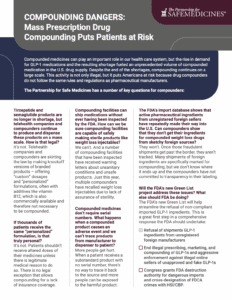
Drug compounding is intended to meet individual patient needs or temporarily bridge shortages — but the GLP-1 market has broken that model. Today, telehealth companies and compounding entities are mass-producing and marketing unapproved compounded GLP-1s. These unapproved versions put patient health and informed decision-making at risk because they are produced outside the FDA’s rigorous review and approval process.
The Partnership for Safe Medicines has published an action plan to ensure enforcement of compounding violations, foreign imports, and deceptive marketing, and guide the creation of new laws and policies that will keep patients safe. Review our factsheet and read the plan to learn about the action plan, and consult the resources below to understand the consequences of weakly regulated compounding.
Also on this page


Compounding basics
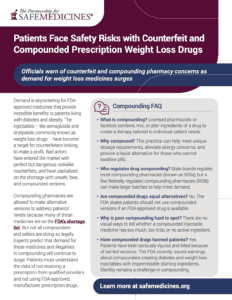
Licensed pharmacists or facilities combine, mix, or alter ingredients of a drug to create a therapy tailored to individual patient needs. This practice can help meet unique dosage requirements, alleviate allergy concerns, and provide a liquid alternative for those who cannot swallow pills.
Who’s behind compounding?
State boards regulate most compounding pharmacies (known as 503a), but a few federally regulated compounding pharmacies (503b outsourcing facilities) can make larger batches to help meet demand.
Are compounded drugs equivalent to FDA approved medicines?
No. The FDA does not review compounded medicines for safety, effectiveness, or quality.
What are the safety concerns around compounded medicines?
While compounders meet important medical needs, the operations can also present risks to patients. Most of the 7,500 compounding pharmacies in the U.S. are not as carefully monitored as FDA-inspected drug manufacturers. Sometimes, compounders use ingredients the FDA has not approved and FDA and customs shipping records show that unregistered manufacturers send massive quantities of API of unknown quality to compounders.
Compounded drugs are also vulnerable to counterfeiting because they do not receive serial numbers for inclusion in the U.S. track and trace system. This makes it more difficult to verify the safety and history of compounded products. The Partnership for Safe Medicines is concerned that not all state regulators have the resources to monitor every company participating in the explosion of compounded weight-loss injectables.
Have compounded medicines harmed patients?
Yes. Compounding pharmacies have distributed medicine contaminated with dangerous bacteria because of non-sterile working conditions; used unapproved ingredients that have not been safety-tested for human use; and used cheaper, research-grade ingredients that are not pure enough for human pharmaceuticals.
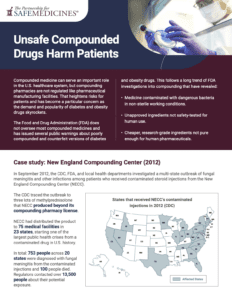
Patients have been sickened and even killed because of tainted versions of compounded medicines. In 2012, the New England Compounding Center produced three lots of injectables contaminated by insects and mold that sickened nearly 800 people and resulted in more than 100 deaths.
Although the Drug Quality and Security Act tightened regulations after the NECC tragedy, incidents like these have continued, and stories are emerging about patients being sickened by compounded GLP-1s.
Download PSM's guides
Mass compounding dangers
Past patient harm
Compounded GLP-1 risks
Compounding info from other sources:
- Compounding and the FDA: Questions and Answers (FDA)
- Compounding: Inspections, Recalls, and other Actions (FDA)
 Compounding news

- Form 483 - Houston RXAugust 2026
- Houston Pharmacy Behind Recalled Compounded Tirzepatide Vials Drew 14 FDA Inspection Observations, Including Exposed Skin and Research-Grade IngredientsOctober 19, 2026
- Apothecary PharmaMay 2025
- Enforcement Report: Tizepatide recall, Apothecary PharmaSeptember 24, 2026
- SA health regulators crack down on compounded weight-loss drugs as pharmacy rules tightenOctober 18, 2026
- Black mold, bugs found at Chinese plants making GLP-1 compounding agentsOctober 15, 2026
- Enforcement Report - Carolina Infusion, IncOctober 9, 2026
- Compounding Pharmacies for Weight-Loss Drugs Are Booming. Should You Trust Them?October 7, 2026
- Policymakers Must Take Action to Preserve the Purpose of Medication Compounding and the Integrity of the Medicine Supply ChainOctober 6, 2026
- Greenwich Rx Issues Voluntary Nationwide Recall of Compounded Glutathione Due to Elevated Endotoxin LevelsOctober 1, 2026