
September 21, 2026: Pill press bill passes House as owners of LFA Machines arrested
Major Stories
Three senior employees of a pill press company have been arrested as the U.S. House unanimously passes the Stop Pills That Kill Act.
Two principal managers and one former long-time employee at LFA Machines, a company selling pill presses and tableting machines, have been arrested. Federal investigators say years-long investigations have not only led to the seizure of the company’s machines at clandestine labs nationwide, but also allege the men sold products to consumers knowing, intending, or having reasonable cause to believe they would be used to manufacture counterfeit pills. In August, an Arizona grand jury indicted LFA Machines and the three men on six counts that each carry a maximum penalty of four years in prison and fines.
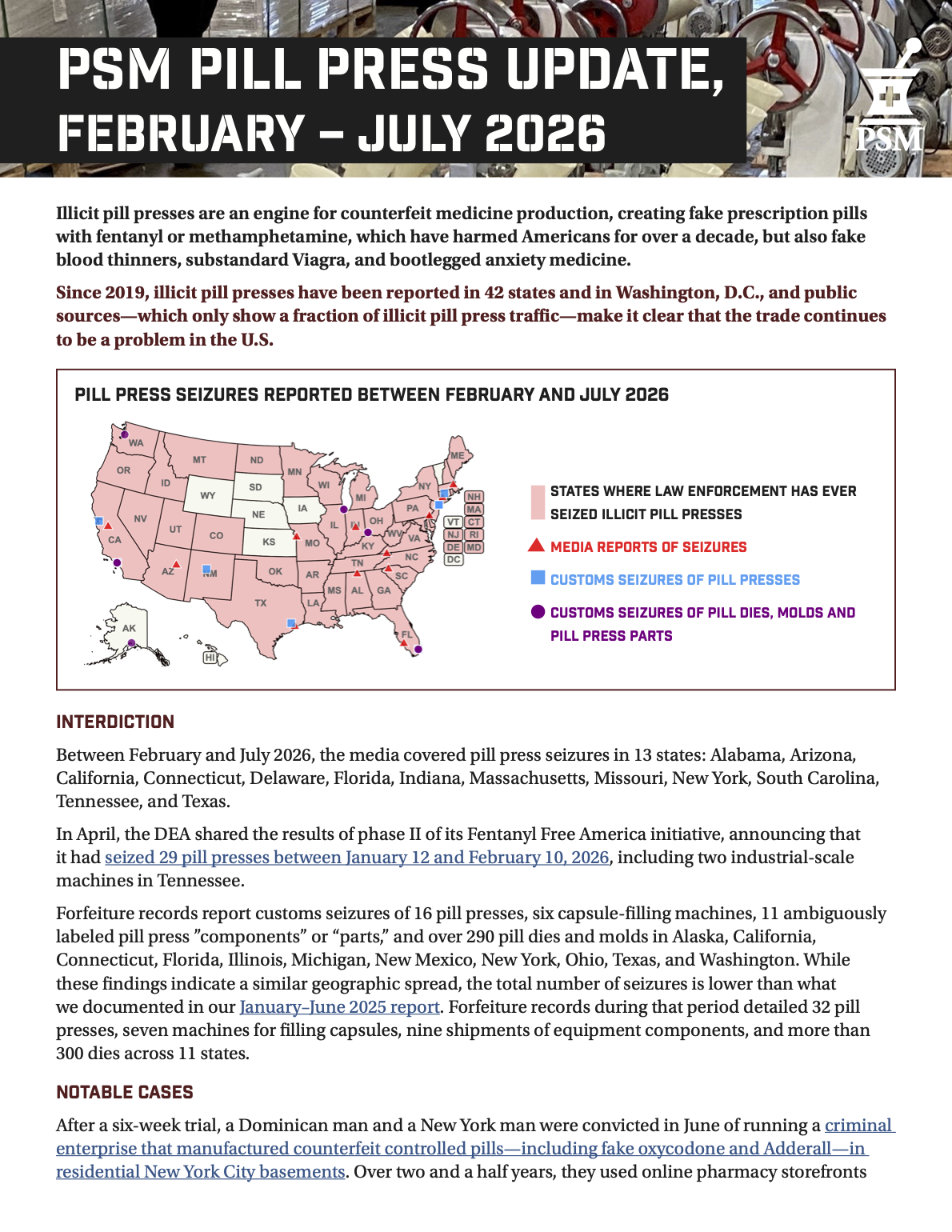
This comes as the U.S. House unanimously passed the Stop Pills That Kill Act (H.R. 8005), legislation that is aimed at disrupting the use of these illicit pill presses to manufacture counterfeit pills. The bill would require pill presses and key components to be serialized, strengthen penalties for removing identifiers or knowingly supplying equipment for illegal drug production, and direct the DEA to develop a strategy addressing counterfeit pills containing fentanyl and other dangerous substances. The legislation comes amid continued pill press seizures nationwide, including 13 states identified in PSM’s latest report and 29 machines seized by the DEA during a recent enforcement initiative.
Domestic
Testing finds that peptides from New York bodegas do not contain what the label claims. CBS finds 35 websites selling the unapproved weight loss drug retatrutide that also tout the LegitScript seal. Study suggests a 33-fold increase in BCP-157 usage since 2020.
After CBS News reported on the peptide craze reaching New York City bodegas in July, WIRED reporters bought and tested vials of PT-141, NAD+, BPC-157, and retatrutide. They found that each substance did not contain the active ingredients on the labels, suggesting that the vials were mislabeled or had been degraded beyond recognition. The testing laboratory could not say what was in the vials.
This comes as CBS News reports that at least 35 businesses selling retatrutide and other peptides had LegitScript certifications, which is illegal and violates LegitScript policy. When the company’s CEO was questioned by CBS, LegitScript took action in most cases, but several companies continued to offer retatrutide, both publicly and privately.
A data analytics firm analyzed more than 15 million electronic health records and identified that over a thousand patients had used the unproven BPC-157 peptide, a 33-fold increase in confirmed users between 2020 and 2026. The study also found that the compound was most often obtained from a compounding pharmacy or black-market vendor. Patients most often discontinued the peptide at their doctor's recommendation, but some cite adverse events.

Attorneys General of at least 19 states have joined in a letter to the Secretary of State urging the federal government to investigate dangerous weight-loss drug ingredients from China that have been linked to warehouses with ties to fentanyl production. The AGs are calling on the FDA to abolish the Green List, citing the warning letter for Harbin Jixianglong, a Chinese company that claimed another company’s products as its own.
Novo Nordisk secured a permanent injunction against telehealth company LifeRxMD, requiring the company to disclose that compounded drugs it sells are not FDA-approved and restricting its ability to use Novo Nordisk’s trademarks in certain ways. Novo Nordisk alleged the company’s marketing equated its compounded products with brand-name semaglutide products, which LifeRxMD denied.
A Crohn's disease patient wrote an op-ed in Maryland Matters concerned that Maryland Prescription Drug Affordability Boards' (PDAB) price caps could prevent patients from getting medicine due to pharmacy closures. In the article, she writes, “If the PDAB truly wants to help patients like me, it should pursue policies that lower costs at the pharmacy counter without dismantling the supply chain that gets the drugs there,” suggesting the state pursue pharmacy benefit manager reform. Learn more about PDABs here.
Michigan State University’s Center for Anti-Counterfeiting and Product Protection published results from an eight-country consumer survey examining online medication-buying behavior. They found that one in five consumers purchased counterfeit medications online, knowingly or unknowingly, and that necessity often motivated these purchases. Drugs in high demand and drugs in shortage pushed consumers to unknowingly take counterfeit versions of a drug, despite the health consequences it could have.
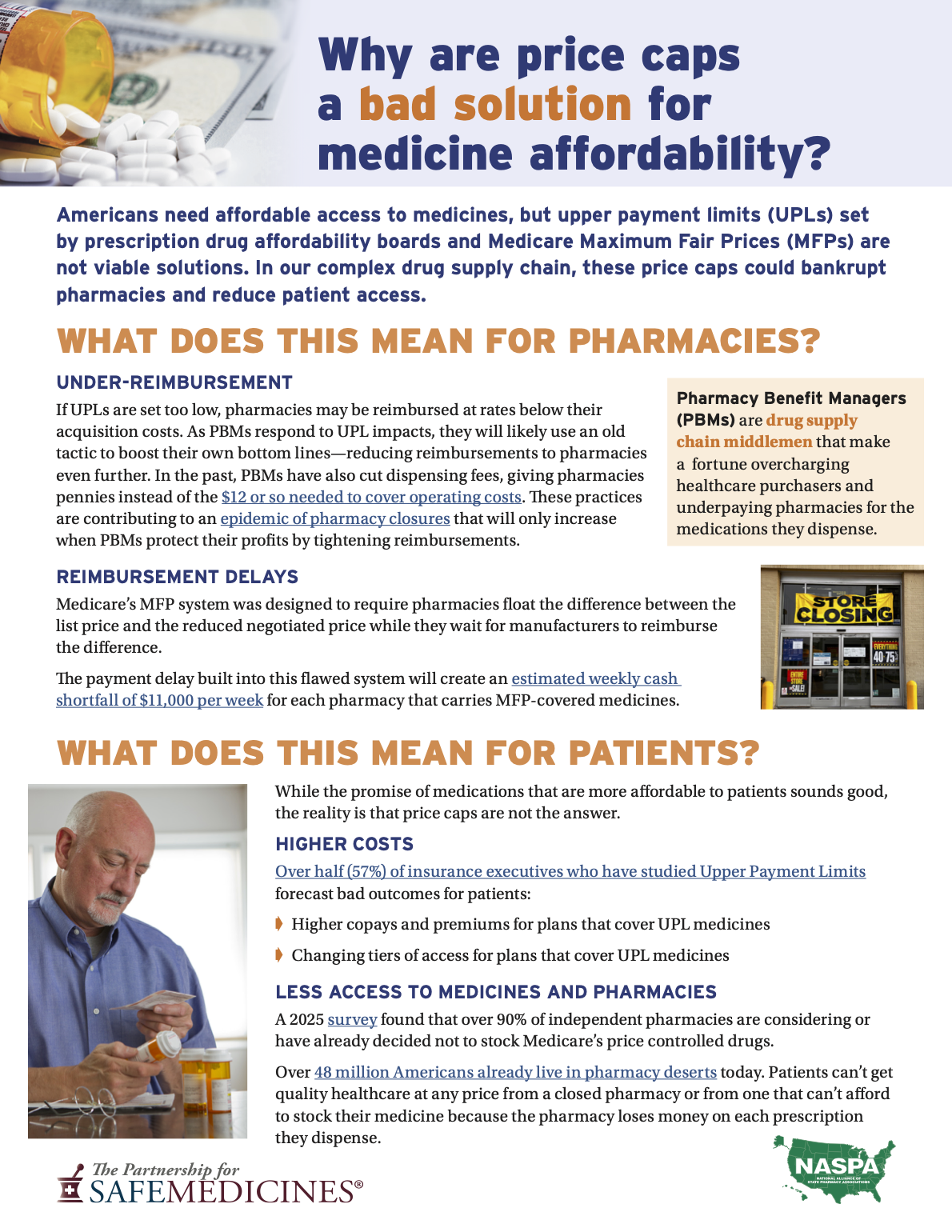
Learn why price caps aren't the best choice for lowering prices.
Pill Presses
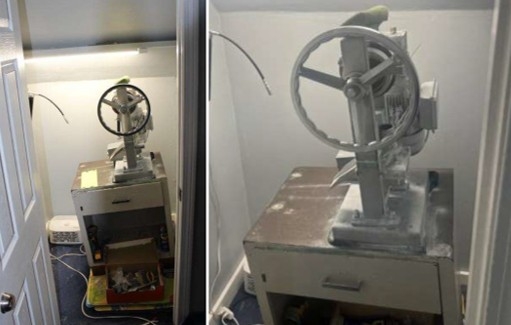
Pill Press found in Massachusettes home. (Photo: DOJ)
A Massachusetts man pleaded guilty in federal court for his role in a scheme to manufacture counterfeit prescription drugs. Investigators seized over two kilograms of controlled substances and a pill press during search warrants related to the crimes. In South Carolina, a man has been sentenced to more than 18 years in prison for manufacturing and distributing large quantities of methamphetamine, fentanyl, and cocaine while using a pill press to produce counterfeit pills.
Regulators protecting patients in the news
A Florida-based eye health company of sterile prescription and over-the-counter drugs was warned by the FDA for “significant inherent contamination risk in your current operation” due to flawed environmental monitoring and manufacturing design. Inspectors noted a trend of excessive microorganism recovery at the facility, the type of which the FDA says indicates water contamination. The agency also said some of the recovered microorganisms were the same genus and species as those recovered from consumer complaint samples.
Want a summary of this news straight to your inbox every week? Subscribe to our newsletter here!
A&P Creations LLC issues two recalls for sexual health supplements that contained undeclared sildenafil and tadalafil.

The Ohio Board of Pharmacy released dangerous drug license suspension notices to five facilities in September, three of which were Texas-based compounding pharmacies. Evoluciona Pharma was suspended after the Board found evidence that it shipped several popular peptides, including BPC-157, that are not eligible for compounding due to a lack of a monograph. Striker Pharmacy, which is being sued by Eli Lilly, is also accused of similar actions, shipping nearly 2,000 prescriptions to Ohio patients. The company also did not release the records of 27 prescriptions of drugs that were ineligible for compounding until the Board asked for complete records and 6 patient profiles. FarmaKeio, the third pharmacy, was issued a suspension notice for shipping drugs with non-FDA-approved components and not having an Ohio-licensed responsible person from 2017 to 2026.
The Board also suspended the dispensing license of a practice that purchased non-FDA-approved drugs from a wholesaler that is not approved in Ohio. The Board says that some of these drugs were biologics, which requires additional licensure to compound. Lastly, the Board suspended the license of a med spa that had unapproved drugs on site from the same unlicensed wholesaler. The doctor at the clinic told investigators that some of the drugs in the refrigerator were for his personal use, that he was aware that the drugs were unapproved, and inspectors found expired drugs in the active drug stock.
International
Indian authorities provide updates on the ongoing investigation into how nearly 90 hospitals were found to have fake cancer drugs and a fake supplement bust.
In their investigation of fake cancer drugs that were found in nearly 90 hospitals and clinics, Indian authorities have suspended the country’s Assistant Drug Controller. The official is accused of having failed to inspect the drugs at the pharmacy that is thought to be responsible for supplying the medicines to the hospitals and clinics, whose owner was recently arrested. The Special Investigations Team formed for this case has also arrested five people and suspended or cancelled the licenses of 17 distributors, including local suppliers of Pfizer, suspected of participating in the scheme. Indian authorities arrested another five individuals for selling fake medicines and supplements at nutrition shops owned by suspects.