

An Arkansas newspaper printed an ad hawking foreign drugs. Are foreign “pharmacies” advertising in your local newspaper? On May 18, 2026, PSM sent a letter rebuking the Arkansas Democrat-Gazette for selling ad space to a Canadian online pharmacy last month. The advertisement, which promised to “save buyer’s up to 80% on their prescription drugs,” promotes…

In a major settlement, Made-in-China.com will stop selling research chemicals to U.S. buyers following an investigation by Connecticut’s Attorney General.

The FDA proposed restricting three GLP-1 drugs from the 503B bulks list, which would prevent outsourcing facilities from compounding them from raw ingredients without a clear clinical need.

The Partnership for Safe Medicines strongly supports the Food and Drug Administration’s proposal to exclude semaglutide, tirzepatide, and liraglutide from the 503B bulks list. This action reflects sound science, sound law, and a clear-eyed commitment to patient safety. Full statement inside.
The former doctor admitted to buying tirzepatide from a lab in China and distributing it without medical evaluations, and is now being sued by a former hospital employee who alleges the drug caused life-threatening complications requiring major surgery.
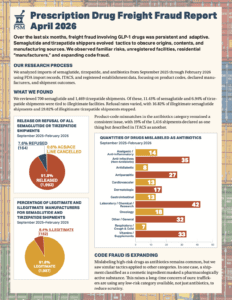
What do FDA records of GLP-1 and antibiotic imports show about freight fraud patterns over the last six months?
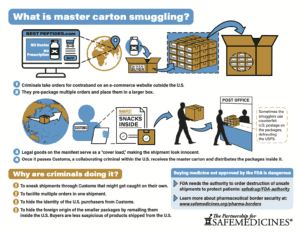
In March, customs officers in Cincinnati announced the seizure of thousands of shipments of GLP-1s and other peptides packaged inside more than 300 “master cartons” with deceptive manifests meant to slip into the country unnoticed. Curious how this smuggling scheme works? Read on.
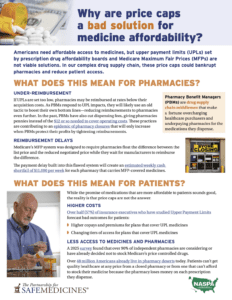
The Jardiance upper payment limit, based on the Medicare maximum fair price, is set to take effect in 2027.
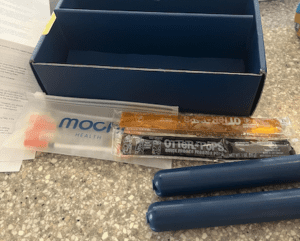
A newly-released March 2025 Washington State Department of Health video shows investigators raiding Aequita, where “cutting corners [was seen] at nearly every level of its operation.”
Is personal drug importation legal in the context of alternative funding programs? The FDA says no.
Are self-funded health plans allowed to import medicine because of “Section 804” or “Florida’s importation plan”? Also, no.